Isolated Conscience

We know the conscience to be the “most secret core and sanctuary of a [person]. There [we are] alone with God, Whose voice echoes in [our] depths.” (Gaudium et Spes, 16) 

The capacity of conscience, though, is not automatic.  It needs certain things to grow.  Grace, certainly, and particularly in the form of encounter with people of varied experience as well as space to reflectively integrate this encounter.  Conscience thus formed leads us to a life animated by and in the service to deep love.

The silos of our world (often ideological, reinforced by social media algorithms and the pesky confirmation bias) hem in our consciences, and make the above ideal hard to experience. 

Pope Francis names this as the isolated conscience, and calls out its contours in Let Us Dream.   

“The indignation of the isolated conscience begins in unreality, passes through Manichaean fantasies that divide the world into good and bad (with themselves always on the good side), and ends in different kinds of violence: verbal, physical, and so on.”

Oof.  

Isolated conscience is no joke.  And it is often subtle, leading to barricading oneself on the moral high ground and limiting one’s love.

How do I participate in the un-silo-ing of my own conscience?  

How might I approach another so that they feel freed to participate in their un-silo-ing?
Same Team!

When I was around seven years old, I started playing YMCA soccer.  Soccer is a tough sport for kids that young and we were, predictably, not very good.

I recall that we would often be so scattered on the field that, without realizing it, we would try to take the ball from our own players. 

When this would happen, our beleaguered coach would yell across the field: “Same team! Same team!”  

He hoped that we would stop, understand what is going on around us, and play with more awareness and teamwork. 

In work, in family, and in the church, we could use someone calling out that we are on the same team.  If we are mired in pettiness or turf battles, recalling that we are on the same team can give us the energy we need to get close enough to love.

Abandon, as in Love or Sleep

This is one of my favorite poems.

And my favorite bit in the poem is:

“Abandon, as in love or sleep, holds them to their way…”

And the word I’ve wondered the most about in that line is

Abandon.

Does it mean “with abandon,” like how a child engages a beloved task?

Or is there an actual abandoning of something non-essential?  A relinquishing?

Perhaps both.  

And if so: What must we relinquish to live into our vocations with abandon?

Laying Out the Pieces

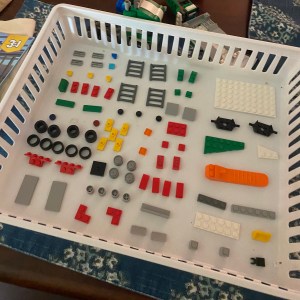
A few weeks ago, when we were together for Easter, my sister’s son did the following for our older son.

As our son was putting his lego set together, his cousin carefully laid out the remaining pieces.

Good spiritual direction does something similar, I think. From a tangle of experience, a loving director is capable of mirroring back our experience in such a way that invites us into clarity.

Show Me the Way

In a poignant scene from the movie Romero, the saint is kneeling in prayer and says the following:

I can’t.

You must.

I’m yours.

Show me the way. 

The first time I heard it, I assumed that each line was a prayer uttered by Romero. So:

I can’t. (as prayer uttered)

You must. (as prayer uttered)

I’m yours. (as prayer uttered)

Show me the way. (as prayer uttered)

I have since wondered if this understanding is also possible:

I can’t. (as prayer uttered)

You must. (as answer received)

I’m yours. (as prayer uttered)

Show me the way. (as prayer received)

Or also, if this understanding is possible:

I can’t. (as answer received)

You must. (as answer received)

I’m yours. (as answer received)

Show me the way. (as answer received)

Other understandings are also conceivable, I think.  Each is a remarkable thing to consider as we take charge of the weight of reality.