It Is Not Too Late

I am ruthlessly protective of my email inbox, subscribing to nothing that is not (to me) consistently valuable. 

A few months ago, the number of things I subscribe to went from two to three.

I signed up for The Daily Difference, the free email published by The Carbon Almanac Network, a source of reliable and easily understandable knowledge on climate change.  Their tagline is: It is not too late.

It is consistently excellent.  No doom, no guilt, no whipping up negative emotion.  Just fascinating, simple insights about how to care for the earth and then tell your friends.

It consistently fills me with hope, and helps me to believe and to act like it is not too late. 
The Sacramentality of Our Lives

The other day, I met up with an old friend who I had not seen for some time.  These types of conversations lend themselves to asking big questions.  Lately, I’ve noticed that, as we get older, both the questions and the answers are becoming more simple.

We asked each other: “What is it that we need right now?”  The answer that we came to was: “to slow down enough to attend to the sacramentality of our lives.”  There it was.  Full stop.

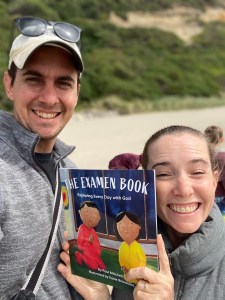
Perhaps more than any other habit, the Examen (prayed with as much consistency as I can muster) helps me to do this.  Appreciation for this form of prayer, as well as our belief that young people have a unique and innate capacity to receive the love of God woven into their lives, led Katie Broussard and I to create The Examen Book.

We are delighted to launch the book this week.  We hope that you will check it out and that it becomes a blessing on your journey.

(PS – If you would like to be one of our first reviewers, email me!  We’ll send you access to the reviewer’s digital version of the book.)

I Don’t Like That!

When our sons are playing, they often fall out of sync.  One begins playing in a way that the other does not like.  The dissatisfied one, then, expresses his displeasure to us about what the other is doing.

We then say, “Please tell your brother how you do want to play.”

And almost always, he will turn to his brother and, focusing once more on the perceived offense, say, “I don’t like that!”

As you surely have noticed, “I don’t like that!” is not a satisfactory articulation of how he would like to engage.

But how often do we do this very thing in public life!  We are experts at saying what we do not like or do not want, and too rarely take the time to articulate a different way forward.  It feels more comfortable to comment instead of contribute

So, if we do not like something that is happening, let’s agree to do the most courageous and productive thing: To say what we do want and what we will commit to in order to bring that thing about.  With imagination and commitment, we can play together differently.

Earning the Miracle?

Our family is fairly in love with the movie Encanto.  Every time we (routinely) listen to the soundtrack, this bit from the introductory “meet the family” song catches my attention.

It’s when the grandma tells us about how the family can “earn the miracle that somehow found us.”

The trouble, as they all learn, is that we can’t earn a miracle.  

The compulsion to try to earn the miracle of our lives, though, is deeply human and imminently understandable.  If I were to earn it, the logic goes, then I would have some control over it.  And how does my ego love to control!

But the wonder of the sacramentality of our lives… the grace woven through our being, the natural world, our relationships, the unfolding of our vocations… is already ours.  No earning necessary.  It’s taken care of. 

The task, then, is to receive these things whole-heartedly and without pretense, as a child.  So freed, we can respond to this abundance with wild generosity.