Last week, I wrote about “brave spelling,” the approach that encourages literacy students, as they learn to write, to sound out a word and spell it as best they can, allowing them to compose fluently albeit imperfectly.
Like this:
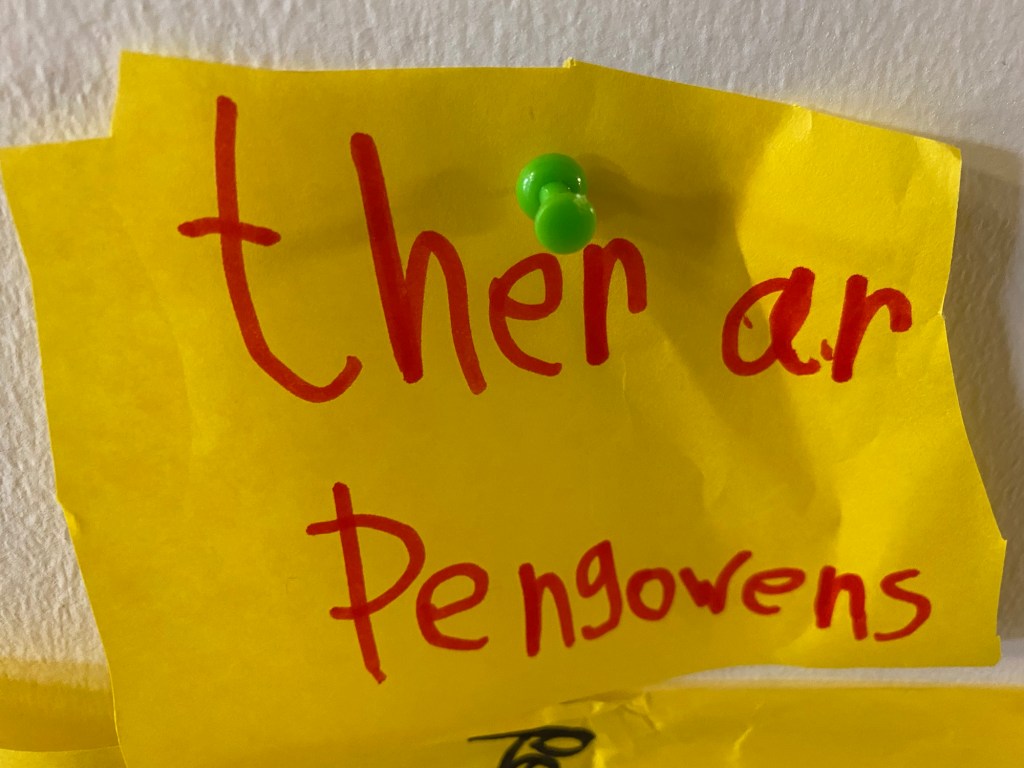
There are penguins!
I am finding that, as a grown-up, reading “brave spelling” is a formative and worthy exercise. Here is the work that it is achieving in me.
I read more slowly. You just can’t read brave spelling that fast. You have to slow down and consider the child and what they are actually saying. This is good. It breaks me out of the habit of considering a text (or a child) habitually and more quickly than they deserve.
I read with tenderness and and a sense of play. Read that penguin example again, and you’ll feel what I mean. Right? Ruthlessly cute. Considering a child with tenderness and a sense of play is a good place to engage.
I suspend evaluation and to compulsion to correct. When first considering a bravely spelled text, the emphasis is 100% on understanding. This breaks my tendency to evaluate and correct.
Our son’s teacher told us that if you do correct, only correct one word per text… but mostly just appreciate the child’s communication. The correct spelling will come. So if I do give feedback, it is occasional and well-discerned.
And I read with a sense of awe. I have no idea how he is becoming literate – but he is, and quickly.
We can learn lots by accompanying someone who is learning.
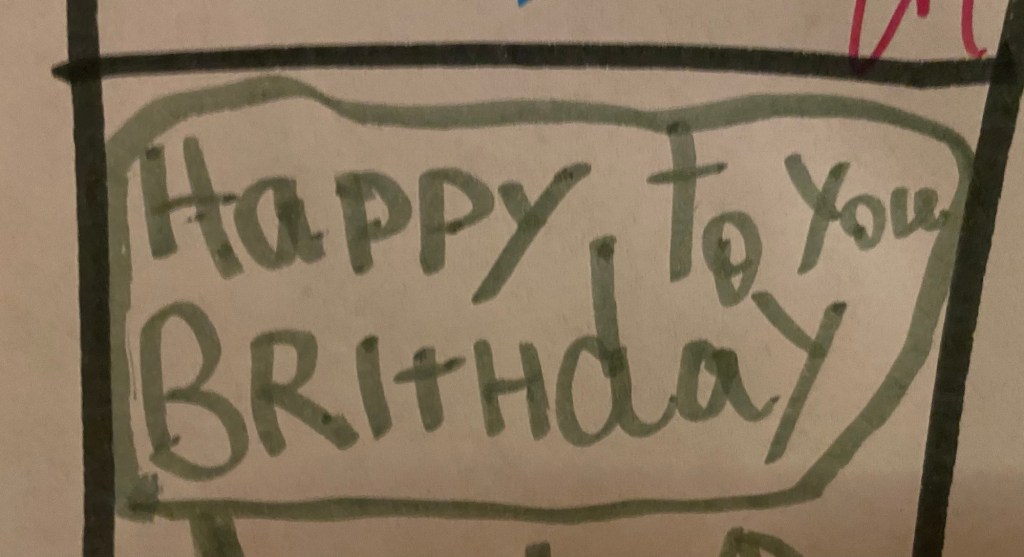
Our first grader is learning to read and write. As he practices writing, his school teaches an approach known as “brave spelling.” That is, he is encouraged to sound out a word and spell it as best he can. He is to articulate his thoughts knowing that they will not be written perfectly.
Here is an example:
He makes mistakes, sure, but this approach frees him to communicate on a surprisingly high level for someone who has just begun to write. And his spelling actually improves in the process of imperfect articulation.
Something similar happens as we learn to articulate our interior lifes… to a loved one, in spiritual direction, in prayer. Of course we will make mistakes as we perceive and share our deepest longings. But in the attempt (and as we ask for the grace to see clearly) our “spelling” will improve. This is a process that continues our whole lives.
Put a different way, if we do not bravely work to articulate our interior lives, I’m not sure we grow much.
“Perfect” is neither possible nor is it the aim. And if we wait for “perfect,” we will never say what needs to be said.
 Paul's Blog