Sandra Boynton and the Necessity of Birthday Cakes

Our younger son just turned five, so we do not reach for the Sandra Boynton volumes much these days.

Still, I often recall my indebted to Ms. Boynton’s work, especially for this gem of an essay published in 2021, around a year into the pandemic.

I find it, as a parent (and especially as a parent who can sometimes undervalue a thing like a birthday cake), to be an essential reorientation around “what is essential.” 

So, parents, thanks for the work that you do, especially in the provisioning of light-heartedness in the life of your littles.

The Tent

Last Saturday morning, our sons wondered: Where was our camping tent?  Could we put it up in the attic to play in?

A bit of context on this tent.  

Once described by a friend as “the condominium,” this tent is wildly fun.  It is a beautifully crafted, with shockingly large dimensions for how sturdy it is… one of those feats of elegant engineering that makes you proud to be a human being.  We stalked the delivery truck for days when it was on its way.

Here is a low quality yet illustrative photo of its dimensions and the Duplo village inside.

And, when we put it up in last weekend, I realized it had been nearly three years since we had used it.  Three years!  What?!  How did that happen?!

I often forget things like this… and also things more fundamental… those resources and realities that, when acknowledged and engaged, lead to an abundant, grounded life.

In other words, what we need is here.

Reading “Brave Spelling”

Last week, I wrote about “brave spelling,” the approach that encourages literacy students, as they learn to write, to sound out a word and spell it as best they can, allowing them to compose fluently albeit imperfectly.

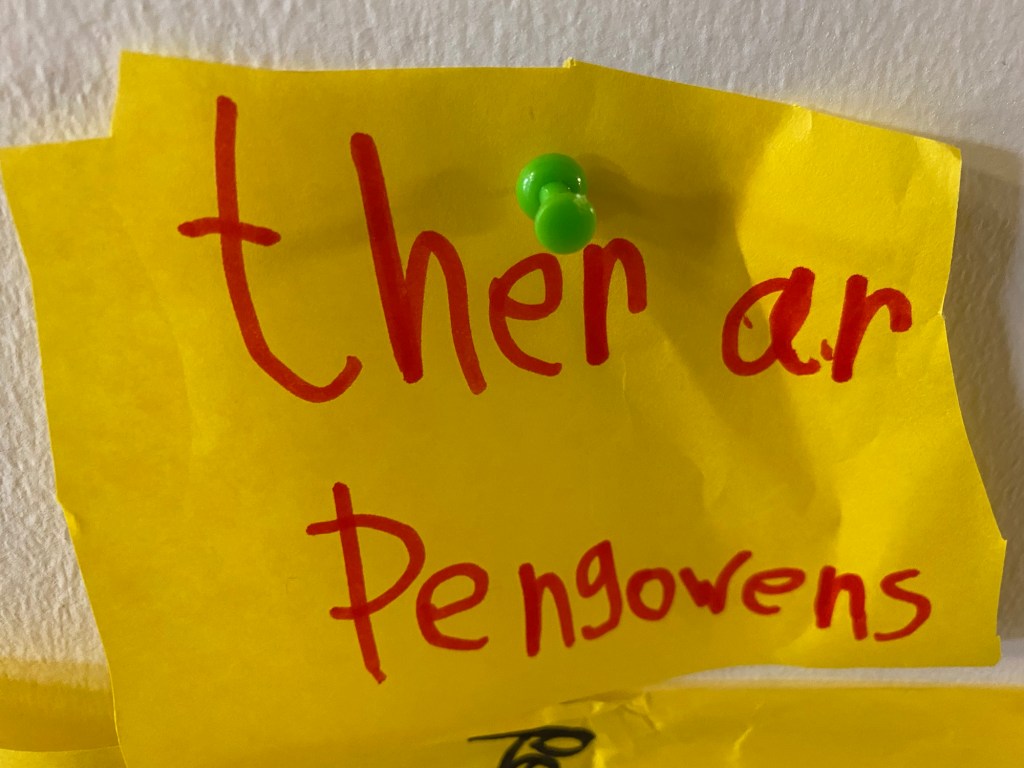
Like this:

There are penguins!

I am finding that, as a grown-up, reading “brave spelling” is a formative and worthy exercise.  Here is the work that it is achieving in me. 

I read more slowly.  You just can’t read brave spelling that fast.  You have to slow down and consider the child and what they are actually saying.  This is good.  It breaks me out of the habit of considering a text (or a child) habitually and more quickly than they deserve.  

I read with tenderness and and a sense of play.  Read that penguin example again, and you’ll feel what I mean.  Right?  Ruthlessly cute.  Considering a child with tenderness and a sense of play is a good place to engage.

I suspend evaluation and to compulsion to correct.  When first considering a bravely spelled text, the emphasis is 100% on understanding.  This breaks my tendency to evaluate and correct.  

Our son’s teacher told us that if you do correct, only correct one word per text… but mostly just appreciate the child’s communication. The correct spelling will come.  So if I do give feedback, it is occasional and well-discerned.  

And I read with a sense of awe.  I have no idea how he is becoming literate – but he is, and quickly.

We can learn lots by accompanying someone who is learning.

Brave Spelling

Our first grader is learning to read and write.  As he practices writing, his school teaches an approach known as “brave spelling.”  That is, he is encouraged to sound out a word and spell it as best he can.  He is to articulate his thoughts knowing that they will not be written perfectly.  

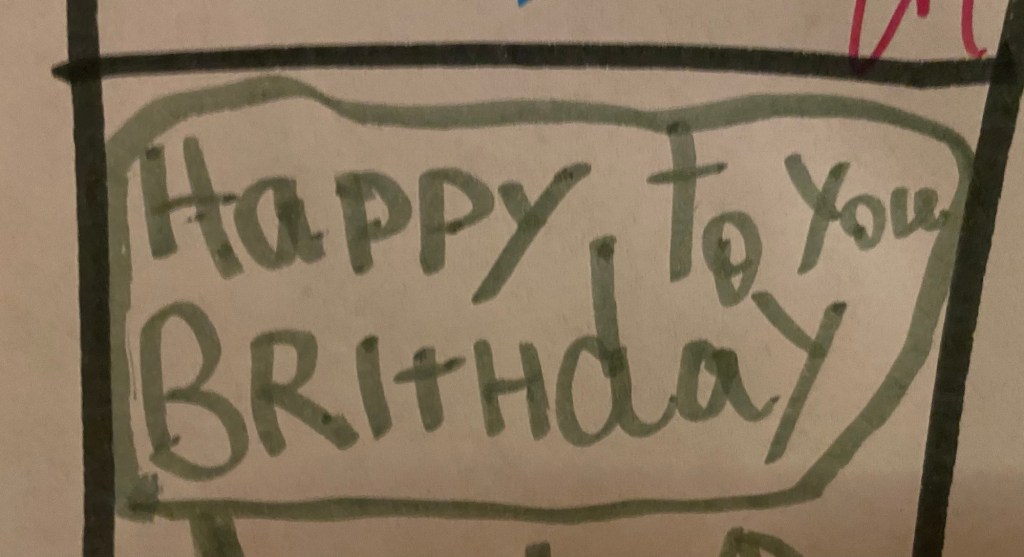
Here is an example:

He makes mistakes, sure, but this approach frees him to communicate on a surprisingly high level for someone who has just begun to write.  And his spelling actually improves in the process of imperfect articulation.

Something similar happens as we learn to articulate our interior lifes… to a loved one, in spiritual direction, in prayer.  Of course we will make mistakes as we perceive and share our deepest longings.  But in the attempt (and as we ask for the grace to see clearly) our “spelling” will improve. This is a process that continues our whole lives.

Put a different way, if we do not bravely work to articulate our interior lives, I’m not sure we grow much.  

“Perfect” is neither possible nor is it the aim.  And if we wait for “perfect,” we will never say what needs to be said.

But Not Yet

Remember St. Augustine’s insightful (and quite humorous, really) quote in The Confessions?

“Lord, make me chaste, but not yet.” (emphasis added)

It’s a wonderfully pithy articulation of that human capacity to hold back from the goodness that we might become.

And of course it applies to anything that takes courage and initiative… that thing that we mean to do, but have just not got around to it.

The momentum of the new year is a great time to push past the “but not yet.”

The Value of an Education

As we graduated from college, Fr. Ted Hesburgh remarked to our class that one way to assess the value of one’s education was to look at the books one is reading, 10, 20, and 30 years on.

What are you reading these days?

(And as 2024 begins, a great question to ask someone you admire is: What should I read next?)

Brain Kryptonite

Recently, I read a study finding that two things wildly diminish our brain power.

One was notifications (ding!) from a smart phone (or computer applications or whatever).

The other was moral outrage.  (Which is different from being principled, generous, and willing to engage the world…)

And it makes sense, right?  The former fragments the attention until it is difficult to focus deeply.  And the latter cuts the roots off of our curiosity.

Beware the brain’s kryptonite.

The Good Apples

In The Culture Code, Daniel Coyle describes that, far and away, the most productive, cohesive, and enjoyable groups have a member that is a “good apple.”

“Good apples” maintain stability and safe connection among the members of the group, so that group energy can focus on doing the work instead of (often anxious) relationship management. With small behaviors, they defect negativity and drain danger from the room.  By subtly communicating that the group is safely connected, they create the conditions for others to perform.

We have each known these good apples, and they are marvelous to work with.

Being a “good apple” takes a certain amount of emotional intelligence and social skill, but it is also a generous choice.