Resistant to Care
“Resistant to care” is a general clinical term used to describe a patient who opposes or impedes the interventions made on their behalf. (In this scenario, their caretakers must be more creative in their care for this individual.) As it concerns our development as loving persons, on some basic level, we are all “resistant to care.” We resist providing the body with what the health it truly wants. We rush by explosions of natural beauty. We don’t adequately attend to children. We get in our own way, complicating our reception of the love that life offers to us. Our task,…
A Monopoly on Pride
It doesn’t exist. Pride, that vice which convinces us of an outsized sense of our own power and perspective, is equally available to all. No single group has a monopoly on pride. And, for St. Ignatius, pride is the vice from which all our other vices flow. Let’s be vigilant when pride is present and pray for its opposite.
Luxuries
Existence as a person in this world A heart that longs for a loved one A body to care for The ability to reach out to another An imagination that can make things or be generous To see creation’s colors These are some of life’s foundational luxuries. They put “luxuries” (typically conceived) in perspective.
And Let It Begin With…
At home, growing up, we would jokingly sing the refrain to the church hymn “Let there be peace on earth” as follows: “Let there be peace on earth, and let it begin with *you*…” While silly, this is too often how we approach all kinds of conflict. Understanding my role in the system of the conflict can help untangle the situation and provide a path forward.
Conversation during the extra mile
Should anyone press you into service for one mile, go with him for two miles. (Matthew 5:41) Walking the extra mile (after that initial distance is completed), what is the conversation like? Does the conversation change? And how? Perhaps one’s inner chatter (about what that person must be like) quiets down, defenses fall, better questions are asked and answered… And as understanding deepens, patience is extended to the irrationality and incoherence present in everyone’s story. This sort of transformation (becoming human, poor in spirit) is on offer for the compassionate and curious traveler.
The Foundational Home
Aristotle explored ethics “[not] in order to know what virtue is, but [that we might] become good.” With what does it begin? The household – our management of it and the formation we internalize while in it. When I am able to see the home not as a not a chore to begrudge, rush through, or outsource – but as a foundation for a deeply good, abundant life, a new way of living opens before me.
In Gratitude
Understatement alert! Many words have been written and spoken about sin. What if any communication on the topic started with St. Ignatius’ contention that a lack of gratitude was the sin to watch out for. How would that change the conversation? “It seems to me in the light of the Divine Goodness… that ingratitude is the most abominable of sins… For it is a forgetting of the graces, benefits, and blessings received.” (St. Ignatius quoted on pg. 110 in The Ignatian Adventure)
The Professional Reader
We rightly appreciate great writing. The value of authors that can teach a distilled concept or weave a magical world is congratulated and remunerated. But what about the value of readers? How might we equally honor the student (or adult) who seeks out varied and worthy writing, courageously struggles to understand its import and beauty, and recreates their vision and engagement of the world in the encounter? An exceptional reader may be just as valuable an exceptional writer – and perhaps more rare. We can choose to become and to appreciate outstanding readers. These days, we need them more than…
Presupposing Goodness
St. Ignatius describes a “presupposition” that should guide the relationship between spiritual director and directee as follows: That both the giver and the maker of the Spiritual Exercises may be of greater help and benefit to each other, it should be presupposed that every good Christian ought to be more eager to put a good interpretation on a neighbor’s statement than to condemn it. Further, if one cannot interpret it favorably, one should ask how the other means it. If that meaning is wrong, one should correct the person with love; and if this is not enough, one should search…
A Smart Phone Benediction
Last year, I saw a US Catholic Bishop interacting with his smart phone in a remarkable way. Before he would unlock it, he would discretely cross himself and momentarily pray. I did not ask him about this practice (I wish that I had!) but I wonder what his intention or petition was as he prayed. What might a “prayer as one picks up their phone” sound like? It’s not a bad idea given the amount of time our devices dominate our attention.
The Three Gates
Our sons’ teacher gives her class the following conceptual hook to think about how they speak to their classmates. She asks them, before they address another, to pass the words they are considering through the following “three gates.” Is it true? Is it necessary? Is it kind? (And kind is not always “nice”… these young people are surprisingly attuned to the need for collegial correction.) If the words cannot pass through the gates, those words can be revised or omitted. The gates can encourage communication too. If we have something true, necessary, and kind to say to a person or…
“If it is not my truth…”
“… then it is a lie.” Living out of this mentality makes us fragile and reactionary. The ability to consider the truth of another’s experience, even momentarily and provisionally, is fundamental to an empathic life in community. This is not a permissive acceptance of everything thought or felt. (So not: “Everything is true everywhere!”) It is an empathic habit that leads to our ability to see the complexity of our world so that we can prudently love within it.
But an Instant
Today, a wonderful line from one of Mark Twain’s personal letters: “There isn’t time — so brief is life — for bickerings, apologies, heartburnings, callings to account. There is only time for loving — and but an instant, so to speak, for that.”
In Time / Out of Time
It is possible to live “out of time.” That is, to cling to a moment, season, or epoch and “how things were then” and “how we thought or spoke back then.” We need not even have experienced this period of time, but have only learned about it. Put another way, it is possible to experience a longing or nostalgia for a moment, season, or epoch that we did not ourselves experience. (This happens in the church today in multiple tribes across whatever spectrum you’d care to map.) And it is a deeply understandable instinct! When we feel threatened or out…
What Is Here That I Have Never Noticed Before?
As I consider: A loved one, as they grow A well-loved Scripture passage That one tree The wonder of our bodies Our attention is necessarily filtered, often to the detriment of our lives. So: What is here that I have never noticed before? (And do I allow myself to slow down enough to hear the answer?)
Reading Buddies
At school, our six-year-old has a reading buddy. Last week, I got to see them in action. Aside from being outrageously cute, this relationship serves multiple purposes. Primarily, our son’s reading buddy offers near instant feedback on decoding and comprehension. For an adult, a worthy way to assess the value of our past education is to consider at the books we are reading 10, 20, and 30+ years after leaving school. Saddling up a classic, complex text, though, can be daunting since few of us have access to the background or support to scaffold understanding of the great books. I’ve…
Characters and Compassion
Like a totally normal person (😉), I’ve been thinking lately about one of the essay questions on an English exam my senior year of high school. The internet helped me find the exact wording. Here it is: Discuss the notion of morally ambiguous characters—those whose behavior doesn’t allow readers to categorize them as purely good or evil. Choose a novel or play where such a character plays a central role, and explain how that character’s ambiguity is significant to the work. For teaching the virtue of compassion, morally ambiguous characters in world class fiction is a fine tool. The point…
Tracks in the Wrong Direction
Near the end of one of Wendell Berry’s finest poems comes the advice to “…Be like the fox / who makes more tracks than necessary, / some in the wrong direction.” The status quo may expect us to seek to maximize our waking hours for pleasure and profit, to always think and speak like our tribe. Life is richer (and more fun), though, when we are led by the Spirit to walk a perhaps unpredictable path, making tracks in the “wrong direction”.
The Edge of the Margin
Near our home is a building boasting a large-lettered sign with the name MarginEdge on top. I assume this is an office of some sort and I have no experience with with them other than seeing their sign, but what a curious idea that sign calls to mind. The demands of life (both real and imagined) can lead us to the edge of the margin of our strength and our time. This is not where the spiritual life thrives. Our story is better written when we are not pushed to the very edge of the paper.
Adversary or Enemy?
So, consider for a moment that person one might disagree with… How we engage them and the story we tell about that interaction turns them into an adversary or an enemy. An adversary is a sparing partner, a worthy rival. An enemy is someone you behold with hostile contempt from whom nothing can be learned. Adversaries can work together to build a healthy community or nation. I doubt that enemies can accomplish this. A final point: It is difficult to behold someone as an adversary if they behold you as an enemy. It is hard, but it is a grace…
Healthspan
I recently heard “heathspan” (how many years one is healthy) contrasted with “lifespan” (how many years one is alive). It’s a generative distinction, helping us focus on the health and quality of the years we live. And what kind(s) of health are we talking about? Bodily, certainly. That is the assumed definition. But also spiritual health? Relational health? Mental health? In each of these areas, do we yet want what we want to want?
The Confederacy of the Humbled
Count Rostov, the uniquely charming protagonist of A Gentleman in Moscow, experiences the loss of stature, influence, and the world he has known. (Not a spoiler! It happens on page 1.) By way of recovery from this loss, he casts a new narrative and describes his inclusion in the “Confederacy of the Humbled”:
“a close-knit brotherhood whose members travel with no outward markings, but who know each other at a glance. For having fallen suddenly from grace, those in the Confederacy share a certain perspective. Knowing beauty, influence, fame, and privilege to be borrowed rather than bestowed, they are not…
God Made That!
For me, one of life’s finest joys is to be so thrilled by the creation of a book that I can’t imagine how it did not exist before. With unique thoughtfulness and passion, Kat Hoenke and Bill Jacobs, both professional ecologists and lay Catholic leaders, invite young people on a journey with the saints and through the bioregions of North America, in God Made That!. (Oh, and they also lead St. Kateri Conservation Center, championing biodiversity on church land.) Thank you, Kat and Bill, for this generous work.
How
The things that we dedicate ourselves to… how do we go about them? Passionately? Frantically? Avoiding commitment and conflict? Relationally? While condescending from the moral high ground? With faith, hope, and love? How we go about what we do means a great deal.
Missing the Meaning
It is possible to have an experience that means to teach us – be it something wonderful or something difficult – and to miss its meaning. Maybe our attention is fragmented or stretched too thin. Maybe we willfully resist the lesson. We should not be surprised if life keeps offering us this lesson because we have, as yet, been unable or unwilling to learn it.
Half of Community
“Half of community is showing up,” a mentor once reminded me. I think that is right. Our presence matters. We cannot make the next important connection if we do not show up.
Fight, Flight, Freeze, Fawn, Fix
When we feel threatened, our brains click over to fight or flight or freeze mode. We attack, run, or seize up. And this does not help us address the “threat” intelligently. Ok, we have heard this before. But there are two more (tricky) manifestations of this that also counterproductive, but less obviously so. (1) FAWN: If the threat is coming from a specific person, we might fawn, resorting to flattery to appease the person and diminish the threat. And (2) FIX: If the threat is a situation, we might jump straight to try to fix the situation before understanding it…
Leading for Lent – Part 2
Two weeks ago, I wondered about what it would look like to take on the discomfort of leading, of gathering a group around a purpose, for Lent. This bit from chapter one of The Art of Gathering nicely focuses the challenge for our times.
Leading for Lent
I’ve heard that action is the antidote to anxiety. Recently, I’ve been wondering if it is not a little more specific.
What if agency, exercising intention and leadership in an uncertain situation, is in fact the way that uncertainty becomes less intimidating and more manageable?
And in situations where we seem to have no agency, we can learn to see that we do have a quite powerful opportunity: the possibility of gathering people together. More than we know, we are capable of convening a meaningful gathering serving a need of people we live, work, or pray with.
Too Expensive
Even if we were given a smartphone for free, it may still be the most expensive thing we own.
Our most precious resources are our time and attention. Smartphones manipulate these two resources in ways that we do not see or even realize.
“Here are all the things to buy,” says the phone, “that will never satisfy. Here is all the curated outrage and anxiety… and here is unlimited access to work (even compelling work!) at all hours at the day or night.”
Unless we take measures to stop it, these things will distract us so thoroughly that we no…
Wanting What We Want to Want
What, in our lives, do we want to want?
Do we want those things / that life now and consistently?
If not, what is keeping us from wanting what we want to want?
What is the 15% we can choose today to move toward that desired life?
Don’t Erase Mine!
Last week at Sunday School, as our son’s class prepared for First Reconciliation, the instructors invited the students into a simple and illustrative activity.
There was a big heart drawn on the board, and the students were invited to fill it with habits and attachments that are not of God.
The point was to show that the sacrament clears our hearts of these things, so that in our hearts might grow the fruits of the Spirit.
When the instructor started erasing the words and narrating the metaphor, one rather exuberant young colleague jumped up and yelled, in full seriousness: “Don’t…
Show Your Work
Through our schooling, our teachers reminded us to show our work. They invited us to make sure our thinking was sound and clear when making an argument, demonstrating a proof, or solving a problem.
Cognitive distortions abound and so teachers who do this well are priceless.
Leaders (that is to say, all of us) need to make a habit of showing our work. As we confront the realities of our day, let’s show our work and invite others to do the same.
Pause Game!
Often, when are sons are in the midst of a rollicking game (often involving an imaginative world of stuffies and legos and a yoga-mat-as-naval-vessel and running amok in our apartment) one of them will yell: “pause game!”
Maybe the energy was too high. Maybe one boysensed that they were out of sync. But the call is always heeded by the other and they take a moment to recalibrate.
In all instances, the pause enhances the play.
This is also true of our lives. Be it sabbath or a daily period dedicated to not doing.
Pausing is what makes our life…
T-I-M-E
We are told that, for a young person, love is spelled T-I-M-E. That is, we love this child best when we consistently offer our undivided attention for meaningful amounts of time.
This may also be how we long for God to love us.
All we must do to make ourselves available to this love is offer our undivided attention for meaningful amounts of time.
Can We Stop Doing This?
As one might expect, our sons occasionally find themselves in a conversational rut. They are going back and forth in a way that makes them both angry and tired.
When they realize this is happening, they’ve started to say (mercifully): “Can we stop doing this?”
When we find ourselves in a communication or relational rut, we can ask the same – to change the dynamic and find another way forward.
Who has permission?
Who has permission to tell you the truth (about yourself or the world)?
Usually we do not give this permission directly (though we can…). We typically give (or withhold) it by the quality of our relationships and the mindset with which we engage.
If a solid group of thoughtful people have a his permission, we can expect to learn a lot.
If we do not give anyone this permission (or give it only to those who think and live like us), we limit our potential intelligence.
The Necessity of Solitude
This week, I’ve picked up this astounding little book again.
Here is part of the author’s riff on the magnificent value of cultivating solitude.
“To be alone is not necessarily to be absent from the company of others; the radical step is to let ourselves alone, to cease the berating voice that is constantly trying to interpret and force the story from too small and too complicated a perspective…”
“It may be that time away from a work, an idea of ourselves, or a committed partner is the very essence of appreciation for the other, for the work and…
First Time, Last Time
When’s the last time you did something for the first time?
Yes, there is much to be said for consistency and the pursuit of focused excellence.
And, developing one’s range is also powerful. The experience of stepping into the unknown (and incompetence!) to learn a new thing is frightening and wonderful.
And using “last time” in a new sense… Our lives are rather short, when you think about it, and there will be a last time that we are able to do something for the first time. This urgency helps us accept the risk of doing something new.
Better Relationships Are Possible
With the earth. With each other. With God.
Better relationships are possible.
For strained relationships to heal, it takes dedicated time and the humility to ask for help.
Introspection and Outrospection
Introspection seeks deeper understanding by turning inward, exploring our own thoughts, emotions, and motivations.
Outrospection seeks deeper understanding by turning outward, focusing on the experiences and perspectives of others, deepening empathy and connection.
We each need both, and probably gravitate to one or the other.
We each may be well-served by practicing the one that does not come naturally.
We Need You to Lead Us
Each of us long for good leaders. People committed to the common good, rooted in wisdom and active love.
I’ve heard this hope expressed in the “prayers of the faithful” quite a bit recently.
What if, as an answer to this prayer, God is speaking you to the world as the leader that you long to see?
Curious or Furious
A moment of anger can be quite involuntary. Something happens, crashing against our expectations of how things should be, and all of a sudden, we are furious.
Okay. But then what happens.
Choosing to fan the fury leads to barricading oneself on a self-righteous patch of moral high ground. Not a fun or productive place to live. This approach keeps us from being able to listen and relate to people who think differently from us. And so, anger keeps us from seeing and responding effectively to the situation that made us angry in the first place.
If we find ourselves…
What’s Your 15%?
In this situation where I feel stuck and stymied, what is in my power to change?
A deeply important question to ask, and one that can be tough to answer well.
I was recently shown this succinct (and fun!) 20 minute group exercise that helps each participant answer the question with clarity and power.
What is your 15%?
Are We in Love With God’s Creation?
Do we love creation with the same love with which God loves creation?
That is a very high standard, an exquisite opportunity, and a grace for which we can pray daily.
Behind the Behavior
When someone does something that really winds us up, what do we learn if we get curious and ask: “What’s behind the behavior?”
If the behavior is particularly perplexing, chances are there’s fear behind it.
When we realize this, and realize our own capacity for fear, it becomes easier to get close enough to love.
Time and Temperature
I saw this graphic this week. It achieves its purpose well.
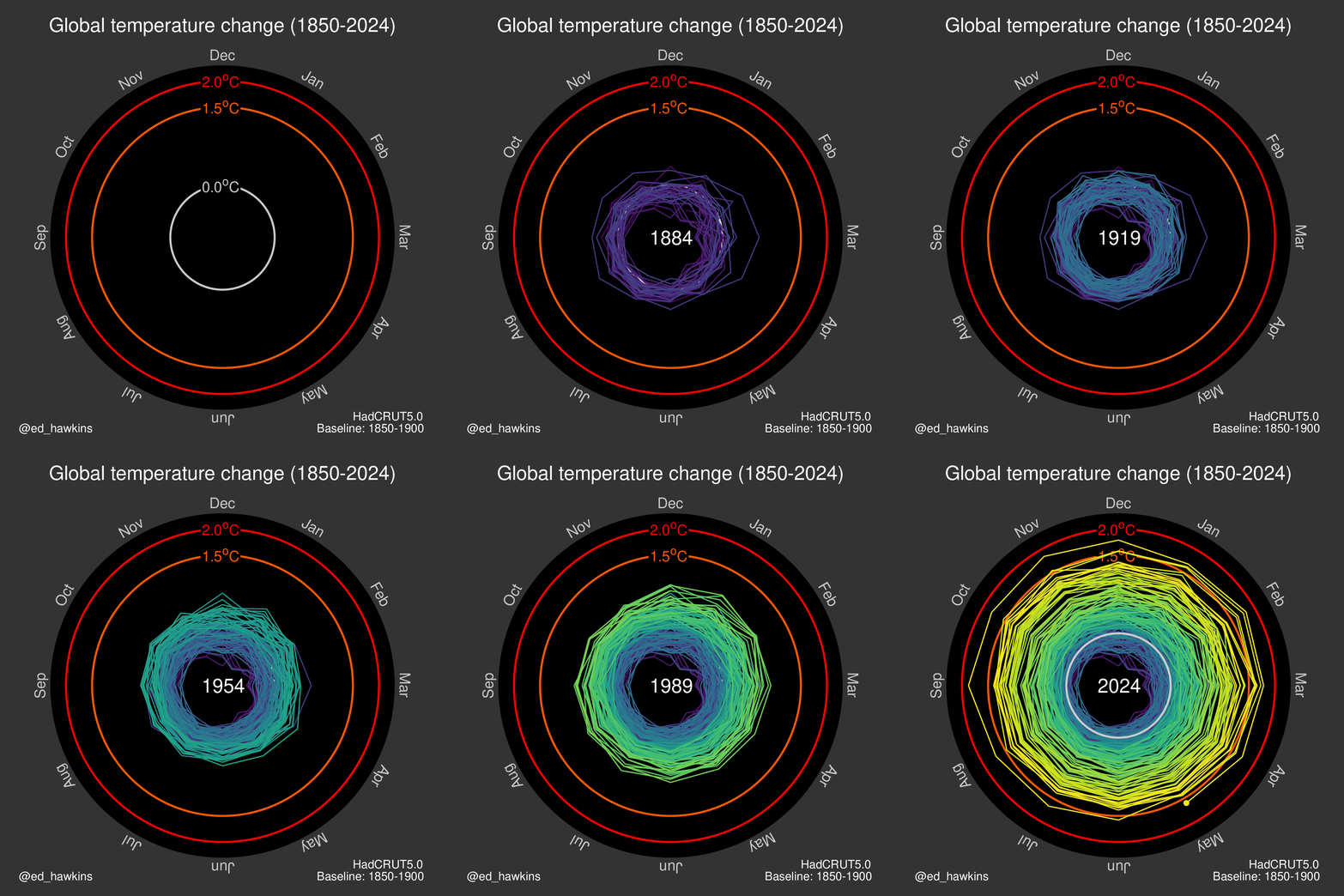
It’s not too late. What if we get it right?
Triple Maximum Speed!
Our sons love to run in a circuit through our apartment. As they do, the younger one loudly reports their movement from “maximum speed!” to “DOUBLE maximum speed” to “TRIPLE MAXIMUM SPEED!”
This is a harmless (so far!) game for them, but for most adults “triple maximum speed” is the uncritically accepted norm of life. We are too often stretched to breaking and do not consider that there is another way. When we do this, we miss the things of greatest value.
These are urgent times we live in… so, let us slow down.
Moving from the Moral to the Mystical
The assembly for the Synod on Synodality opened yesterday. Let’s pray for the folks in the mix… pray for the grace to embody this outstanding passage by Henri Nouwen.
“Christian leaders cannot simply be persons who have well-informed opinions about the burning issues of our time. Their leadership must be rooted in the permanent, intimate relationship with the incarnate Word, Jesus, and they need to find there the source for their words, advice, and guidance. Through the discipline of contemplative prayer, Christian leaders have to learn to listen again and again to the voice of love and to find…
Tithing Time
Tithing has typically meant donating money.
What would it mean to tithe a more precious resource, our time?
To offer a choice piece of our time each day to prayer and contemplation?
And then to meaningfully connect with another about the world we long for?
The MGI
St. Ignatius wrote in annotation 22 of the Spiritual Exercises that “every good Christian ought to be more eager to put a good interpretation on a neighbor’s statement than to condemn it.”
What is on offer here is to habituate the MGI – the most generous interpretation – which holds the door open for curiosity, learning.
This is difficult. Our brains are wired to scan the world for threats in order to keep ourselves safe. It is possible, though, that true safety may be arrived at only when a big group of us are able to default to the MGI.
Courageous or “Morally Superior”?
When we find polarization in our world (and we all do all of the time), do we engage it such that we might solve the underlying problem? Or do we engage in order to feel morally superior?
This outstanding video frames the question brilliantly.
Attachments
Attachments to the things that do not satisfy are like this.

Every day is a new opportunity to ask for the grace to let go of the bars and simply walk away.
Speed Reading a Poem
It’s a ridiculous idea, right?
The whole point of a poem is to slow down, savor the beauty of the words, and allow the meaning to emerge.
And yet, are we not often guilty of “speed reading” the best part of our lives? The people we have been given to love. The wonder of the natural world. The delightful complexity of our interior lives and our walk with God.
Let’s pray for the grace to read slowly.
The Adjacent Possible
The easy problems are all taken. That leaves the hard ones.
What an opportunity!
So, yes, the solution to the hard problem you have taken on is not immediately in sight.
But what is the next move? And once you move there, what can you see now that you could not see before?
Clarity may come once you move into the possibility adjacent to your current position.
You Can’t Make Old Friends
Have you heard “You Can’t Make Old Friends” lately? The journey that the first two lines can take us on is worth the click.
Maybe I love the song because an old friend of mine loves it, but I think there is something more.
I think it represents one of the gentlest memento mori moments around, reminding us to consider what is most valuable to us and that we do not get forever to cultivate and delight in those relationships.
The Audacity of Ignatian Spirituality
Happy (belated!) Feast of St. Ignatius!
Recently, to celebrate the feast day, I had the pleasure of joining a Loyola Press webinar on the “Audacity of Ignatian Spirituality.” Here it is! (Thanks to Joe and Denise for the helpful bookmarks throughout the recording.)
(And – hey – the name of that webinar reminds me of a cool little book!)
Spirituality for Extroverts
Last week, I wrote that I would write about Fr. Tom McDermott, CSC and appreciate the unique and remarkable person that he was. I have struggled in the attempt – it feels small and incomplete – but I offer the reflection here since the church so desperately needs leaders with Tom’s strengths. Here are five:
1) Tom’s pastoral default was to go to the margins and learn from the poor. He did this everywhere he went, including when he moved to Dhaka in his late fifties to begin his final apostolate. Last year, at the age of 73, on…
Time-bound
We move back to the United States this coming week.
Some weeks ago, a friend asked why we were leaving Germany. I told him that our tour was only two years, and those years are wrapping up.
“Ah,” he said, “so you knew from the beginning that it was all time-bound.”
I liked how he put that, and have thought about it the days since. It is true of our time in Germany, and it is true of our time on the earth.
We know from the beginning that our whole lives are time-bound. We don’t get forever here.
While…
Teams of Rivals
Team of Rivals tells the story of how Abraham Lincoln invited political opponents to serve as trusted members of his cabinet. He did not steamroll or manipulate them. He listened to them and learned from them and the wisdom he gained from this interaction helped him navigate the American Civil War.
Each of us can decide to engage others who do not think how we think or believe what we believe, and so create our own team of rivals. Doing so is a massively valuable and generous choice.
Institutions are strong and wise to the extent which they can…
Required Reading
The Ministry for the Future is a “climate fiction” novel that compellingly “plays forward” climate change. (The book was published in 2020, and the plot begins in 2025.)
The action centers around the “Ministry for the Future,” a global organization that advocates for future generations.
It is an ultimately hopeful book, that is also heart-breaking and life-changing.
Every human being should be offered a copy and encouraged to read it.
The Keynote Listener
We have all been to events with a keynote speaker. A recognized expert in a subject is given time to inform or inspire.
It is a known meeting structure. The speaker has the microphone. We sit and listen.
Last week, I talked to a group that does things differently. They organize gatherings around a keynote listener. (Very cool!)
The keynote listener is a recognized expert in creating a gathering in which other people feel comfortable sharing their experience and wisdom. The keynote listener listens at this gathering, and then at the end of the meeting, synthesizes and summarizes so that…
Cynicism is a Choice
And it’s a bad choice.
Clear-eyed and truth-seeking, yes, but not cynical.
Cynicism accepts and reifies the worst parts of the status quo. It paralyzes us and wastes our energy by focusing on things we cannot control.
And it subtly lets us off the hook. (“Look at those people over there who are the problem. Nothing I can do about it.”) The cynic barricades themselves on the moral high ground and feels superior while contributing little.
The cynical mindset forgets that we are all capable of evil and all caught up in a system where it is often hard to…
Unterbrechung
When Johann Baptist Metz was asked to describe the meaning of religion in one word, he replied with Unterbrechung – German for interruption.
Outstanding, right? Because when we hear this, we must then consider what, in our lives, must be interrupted.
Is it the self-satisfaction that characterizes much of religious practice? (Or the self-satisfaction that turns away from it?)
Is it the speed of our lives or any elements of egotism that hides within that speed?
Or maybe it is an interruption from anything that keeps us from the love we are meant for?
How can we cultivate the disposition…
The Suscipe’s Nouns
In the Suscipe prayer, one offers to God four things without reservation: one’s liberty, understanding, memory, and will.
People who do this consistently have always been remarkably valuable to the communities of which they are a part. They are teachers of what is ultimately valuable, lights on the path of where we are to go.
In our present world, the value of this asset is on the rise.
Consider the Suscipe’s nouns in an age of AI. Even the models available now are potentially massive aids to our understanding and memory, and they are only going to get better. …
The Hero Chooses Mortality
In the Odyssey, the first time we meet Odysseus, he has been offered by Calypso a life of ease and pleasure without urgency or end.
He rejects this offer, choosing instead a life of mortality and reality. He chooses the trial that will lead him home to his wife and son, to his real life.
This hero’s journey starts by choosing to be mortal.
Like Odysseus, when we recognize and embrace our own mortality, the adventure of our life deepens. This recognition of our limitedness helps us to live well and urgently.
Yes, mortality has been chosen for us, as…
A Joyful Announcement (And a Humble Request)
I am delighted to announce that Sorin Starts a School has been officially adopted by Ave Maria Press. It is now available on their website and on Amazon.
We are thrilled to partner with a ministry of the Congregation of Holy Cross on a book that foregrounds their charism.
And might I hazard a request of your time today? In the world of Amazon, a lot hinges on the number of reviews for a given book. Might you click through and write up a short review today?
(If you don’t have your copy handy, I’ll…
What’s the Problem Here?
Over the past months, I’ve been trying to learn how to interact productively with ChatGPT 4 on a programming project. I am only at the beginning of my understanding, and, while it is certainly not perfect, it is shocking useful at many tasks.
(Aside: Haven’t thought about using one of the new AI models or not sure where to start or not sure what to make of it all? Co-Intelligence is an outstanding read.)
And there is something AI can’t do, insofar as I can tell: It can’t tell me if I am focusing on the right problem.
…
The Immense Call of the Particular
This child.
This spouse.
This project.
This tree or bird or blossom.
This interaction.
This prayer.
This moment.
Today, we have been given some things – not all those other hypothetically “better” (as whipped up by an anxious mind) things – but these things that are here, now.
These things, in their particularity, call to us.
Let’s attend to and answer the immense call of the particular. Grace lies within.
Less Than God Desires
It is possible to do more than God requires and less than God desires.
In fact, this may be the default way of living in our culture, even inside of the church.
What, then, does God desire?
Well, undoubtedly more than we might ever comprehend, but perhaps primarily to know how profoundly we are loved. To accept the gift of the wonder of being alive, of this world.
Knowing oneself as infinitely loved by God changes everything, and enables clearer vision of what might, then, be required.
Information Is Not Scarce
Information is not scarce. If you are curious about a topic, the internet will have you drowning in information.
What is scarce, though, is taking the initiative… acting generously on the information that we do have.
Remote Control
Our boys enjoy the occasional “what if” game. The other day our older son asked, “what if you could *only* move when someone told you to move?!”
His brother then began to “control” his movements with his speech. And if his brother didn’t tell him to move, then he was stuck.
If we are attached to the approval of others, our actions are bound in a similar way. We are subject to either manipulation or paralysis.
Far better to root in something real.
Majoring in the Minor
It is possible to not realize that we spend a disproportionate amount of our energy on things of little consequence. When we do, we major in the minor.
We do this with our health when we obsess about a dietary detail, but don’t exercise much or give ourselves the chance to sleep well.
At work this can happen when we clamp down on a problem the resolution of which will not actually move us forward.
And then, with limited time left, we minor in the major.
The tricky part is that majoring in the minor feels like we are doing…
The Path
This is the walkway from the street to our house.

A few weeks ago, four workers took up about a third of the bricks (the part that is darker on the left side), dug a trench, laid some wiring, filled in the trench, and placed each brick evenly back in place.
Brick by brick is the only way to do this job.
Many valuable tasks in life are like this. Showing up consistently to a routine of prayer. Working an hour a day on a generous project. Attending to the individuals in our life with active…
Attention Intention
Every day, our children notice what captures our attention. They take outstanding inventory of our focus and so come to know what we value.
Realizing just how much they understand helps me become better than I might otherwise be. Principally, this entails decreasing the number of things that I try to pay attention to.
Buyer Beware
Sure, this applies to the stuff that we trade for money.
But even more importantly, it applies to the stuff to which we give our time, attention, emotional energy.
When we choose to spend time doing something, we are “buying” that thing with our most precious resource.
The Opposite of a Sandwich
When we enter the world of Maurice Sendack, Fred Rogers, Roald Dahl, Mo Willams, or the geniuses who write and produce Bluey, we know instinctively that we are in the hands of special people.
They have clearly cultivated a special attentiveness to children and then create a world rooted in this tender perception that invites all to rejoice in a child’s way of proceeding.
Our boys have stumbled upon another writer with this same gift.
Abby Hanlon’s Dory Fantasmagory is a delight for all comers, especially sassy younger children who may feel a little left behind…
The Value of Discomfort
The most valuable things reside on the other side of discomfort.
The vulnerability of commitment.
Sharing something that is deeply important to us with another.
Taking the first awkward steps to learn a new skill set.
Sitting in quiet non-judgemental awareness with one’s own mind.
These moments can be quite uncomfortable… but if we are able to see this discomfort as something enormously valuable, then we are able to grow.
Light for Our Feet
One night some years ago, when I was living in Uganda, I was walking home alone.
There was no moon, and when the power went out (there was frequent load shedding) I was about a quarter mile from home. It was completely dark. I could not see a thing.
Or so I thought at first. But standing there, after my eyes adjusted, I realized that I could see just a tiny bit, enough to move a little bit closer to home with each small step. Sure, I ran into a few bushes, but I did arrive safely.
When navigating life’s…
Seeing From the Inside
Last week, I watched a Broadway production of Our Town. (It’s delightful, and free on YouTube.)
It was my first exposure to Wilder’s play, and it was wonderful, on multiple levels.
One of the main themes (it seems to me) is that it is a real challenge to see the wonder of one’s life from the inside of that life, in real time, as we live it.
There are many reasons why this could be true: the uncharitable noise inside one’s head, daily demands, anxiety or false imaginings about the about the future… it is no surprise that the…
The Impermanence of Ability
Our bodies enable us to do remarkable things. None of these abilities is permanent.
Clarity of thought.
Strength of sight.
Dexterity and balance.
Durability of concentration and memory.
Strength of muscles, joints, bones.
In my longevity’s best case scenario, I will live long enough to experience the decline of these things.
Given this, to what will I dedicate my days?
Sandra Boynton and the Necessity of Birthday Cakes
Our younger son just turned five, so we do not reach for the Sandra Boynton volumes much these days.

Still, I often recall my indebted to Ms. Boynton’s work, especially for this gem of an essay published in 2021, around a year into the pandemic.
I find it, as a parent (and especially as a parent who can sometimes undervalue a thing like a birthday cake), to be an essential reorientation around “what is essential.”
So, parents, thanks for the work that you do, especially in the provisioning of light-heartedness in the life…
The Tent
Last Saturday morning, our sons wondered: Where was our camping tent? Could we put it up in the attic to play in?
A bit of context on this tent.
Once described by a friend as “the condominium,” this tent is wildly fun. It is a beautifully crafted, with shockingly large dimensions for how sturdy it is… one of those feats of elegant engineering that makes you proud to be a human being. We stalked the delivery truck for days when it was on its way.
Here is a low quality yet illustrative photo of its dimensions and the Duplo village…
Creating the Conditions That We Long For
We all desire to be connected, but hesitate to connect.
We all want to be seen, but rarely submit to the discipline of really seeing another.
We all love to be part of a thoughtful gathering, but often lack the initiative to plan a gathering and then extend an invitation.
Opportunity lies within.
Who’s In Charge Here?
That situation that ramps us up emotionally…
Am I in charge of that situation?
Or is that situation in charge of me?
If I can sit with what makes me upset, I am on the path to responding wisely and prudently.
If not, I won’t ever be in charge.
Reading “Brave Spelling”
Last week, I wrote about “brave spelling,” the approach that encourages literacy students, as they learn to write, to sound out a word and spell it as best they can, allowing them to compose fluently albeit imperfectly.
Like this:
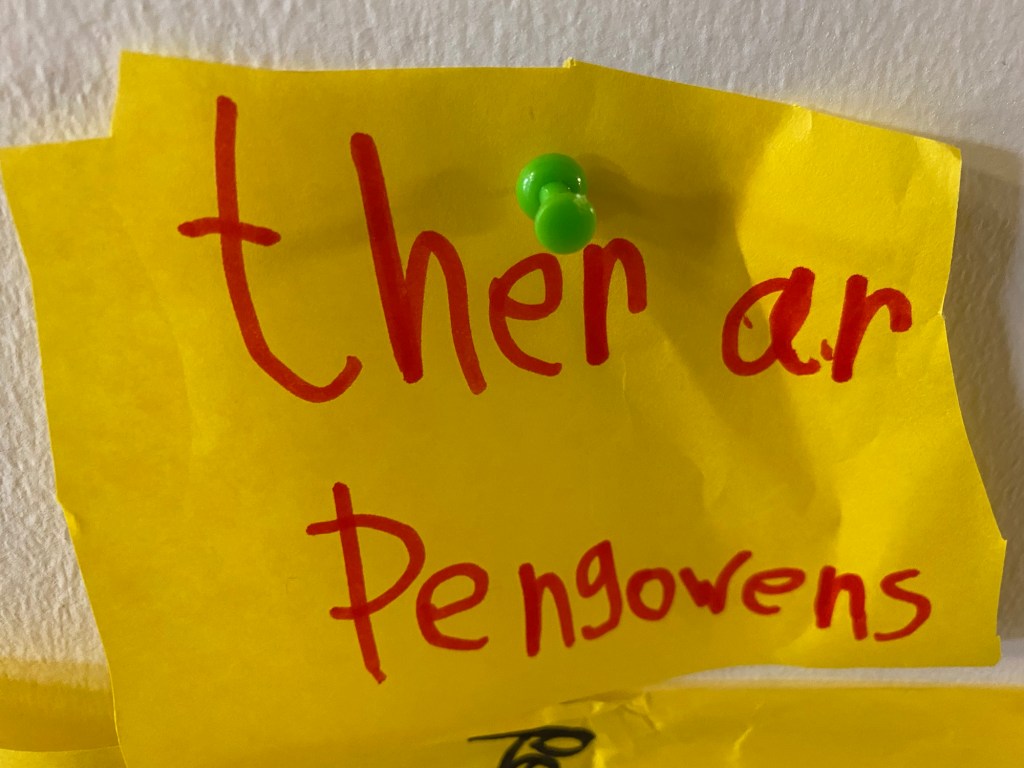 There are penguins!
I am finding that, as a grown-up, reading “brave spelling” is a formative and worthy exercise. Here is the work that it is achieving in me.
I read more slowly. You just can’t read brave spelling that fast. You have to slow down and consider the child and what they are actually saying. …
Brave Spelling
Our first grader is learning to read and write. As he practices writing, his school teaches an approach known as “brave spelling.” That is, he is encouraged to sound out a word and spell it as best he can. He is to articulate his thoughts knowing that they will not be written perfectly.
Here is an example:
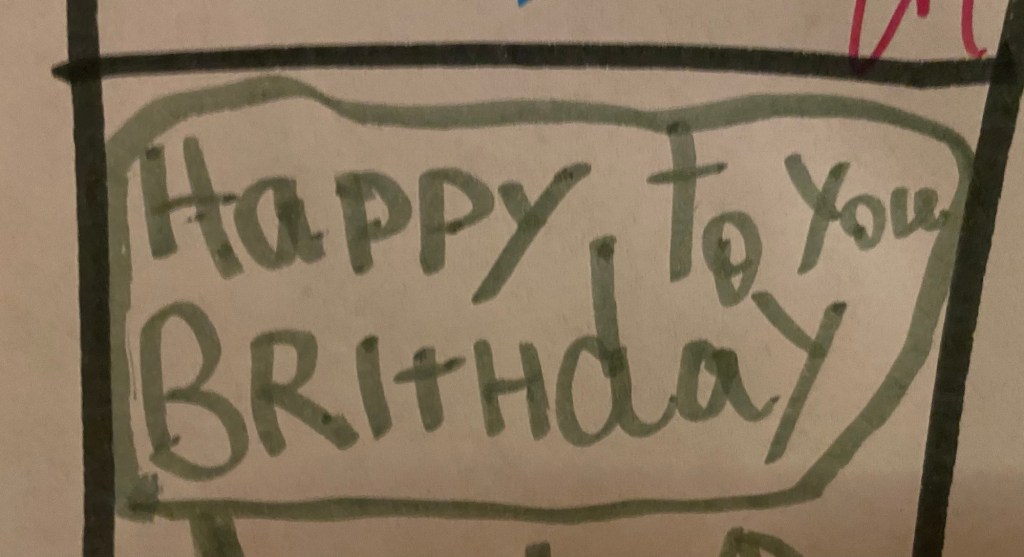
He makes mistakes, sure, but this approach frees him to communicate on a surprisingly high level for someone who has just begun to write. And his spelling actually improves in the process of imperfect articulation.
Something similar…
But Not Yet
Remember St. Augustine’s insightful (and quite humorous, really) quote in The Confessions?
“Lord, make me chaste, but not yet.” (emphasis added)
It’s a wonderfully pithy articulation of that human capacity to hold back from the goodness that we might become.
And of course it applies to anything that takes courage and initiative… that thing that we mean to do, but have just not got around to it.
The momentum of the new year is a great time to push past the “but not yet.”
The Value of an Education
As we graduated from college, Fr. Ted Hesburgh remarked to our class that one way to assess the value of one’s education was to look at the books one is reading, 10, 20, and 30 years on.
What are you reading these days?
(And as 2024 begins, a great question to ask someone you admire is: What should I read next?)
Brain Kryptonite
Recently, I read a study finding that two things wildly diminish our brain power.
One was notifications (ding!) from a smart phone (or computer applications or whatever).
The other was moral outrage. (Which is different from being principled, generous, and willing to engage the world…)
And it makes sense, right? The former fragments the attention until it is difficult to focus deeply. And the latter cuts the roots off of our curiosity.
Beware the brain’s kryptonite.
The Good Apples
In The Culture Code, Daniel Coyle describes that, far and away, the most productive, cohesive, and enjoyable groups have a member that is a “good apple.”
“Good apples” maintain stability and safe connection among the members of the group, so that group energy can focus on doing the work instead of (often anxious) relationship management. With small behaviors, they defect negativity and drain danger from the room. By subtly communicating that the group is safely connected, they create the conditions for others to perform.
We have each known these good apples, and they are marvelous to work with.
Being…
The Mastery Response Narrative
When I was coaching teachers, the centerpiece of writing a good lesson plan was called the “Mastery Response Narrative” (or MRN). It was the narration of how one arrived at the completion of the task to be mastered.
So, take a simple example: Say, in Spanish class, the students were to learn how to conjugate a regular “-ar” verb.
The “target task” to be mastered would be: “Write ‘I speak’.”
The “mastery response” would be: “Yo hablo.”
And then the MRN: “I know that the infinitive of “to speak,” in Spanish, is “hablar” which is a “regular” verb… the base…
Audacious Ignatius, Adopted
Five years ago this week, Audacious Ignatius was born.
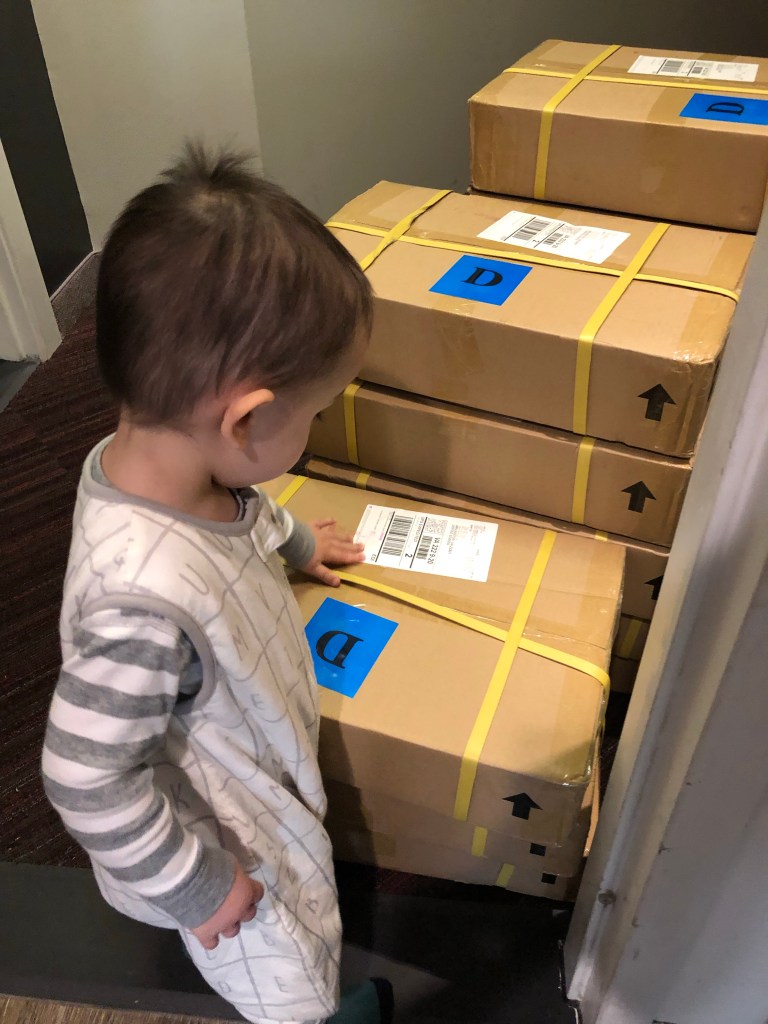
With joy, gratitude, and lots of mailing tape, I packed up all these boxes on our kitchen counter and brought them to the local post office to share with folks who believed in the project from the moment we shared it on Kickstarter.

And what a brilliant first five years it has been… What has made this project so rich is the partners and companions that generously lent feedback and enthusiasm to the…
Seeing as Though Our Life Depends on It
Everyone has someone with whom it is difficult to get along.
What if we were to live as though this person holds the key to some knowledge that our life depends on? What if we knew we would learn a crucial lesson if we could just quiet the story about them in our heads long enough to actually see them in their fullness?
I believe that our life together *does* depend on this type of seeing.
It’s time to get curious about that person and to learn something through the process.
Small Stories
Solitude allows us to slow down and consider how very small and needlessly complicated are many of the stories we rehearse within our heads.
(“Small” and “complicated” seem, at first glance, to be opposites, and yet, that is exactly what these unworthy stories are.)
Letting go of these stories frees us to receive the gift of the story of how profoundly we are loved.
The Final Freedom
Viktor Frankl named “the last of the human freedoms” as the ability “to choose one’s attitude in any given set of circumstances… to choose one’s own way.” (Man’s Search For Meaning)
And, of course, he has serious authority. This assertion was made as he reflected on his time in four different concentration camps.
His point is universally important and applicable: how we face the day is a deeply moral and creative act.
Every moment offers us the possibility to change the story to be more constructive, more loving, more curious.
The Silent Request
I am rereading the remarkable Religious Potential of the Child, and was stopped short by this sentence which begins the third chapter.
“The adult who accepts the silent request of the child: “Help me to come closer to God by myself,” must choose the way to give the child the help [he or she] asks for.” (page 33)
Whoa!
And, I wonder if this is actually the silent request of all to show up in a given faith community.
What would it mean to prioritize attentiveness to this longing? How would the church change?
I think we would become…
Free Will
In college, I recall discussing “human free will” as a sort of a given, an endowment that we are born with, like our bones and muscles.
The mystics and behavioral economists, though, show us that this is hardly the case. The freedom of our will is only a potential within us and something that, with grace and intentional work, we can slowly actualize.
That is, so much of what I think are “my actions” are only reflexive reactions, based on my mental and physical makeup, my past conditioning, my environment. I have been programmed, by nature and by nurture, to…
Turning Two
Sorin Starts a School is turning two!
It’s been a pretty fun two years, making connections with communities for whom the book is a gift and receiving the news of its Moonbeam award.
To celebrate, we’ve made a curriculum guide for Sorin Starts a School in order to make it easier for educators at Catholic schools and parishes to plan lessons that lead to the heart of our tradition and to the charism of the Congregation of Holy Cross.
Here is the link to download the guide. Please share it with your educator friends!
And below is…
The Hypocrite’s Preamble
I recently heard someone deeply committed to the mitigation of climate change begin an interview with the following.
“Regarding climate change and the alignment of my actions with what I know I should do, I want to acknowledge that I am and have been a hypocrite. And I also think that in the West we are largely all hypocrites. Now, with that acknowledged, lets focus on how we can do better together.”
Whoa!
I think this “hypocrite preamble” is immensely helpful. Many fears hold us back from acting as we ought, and chief among them is being outed as a…
 Paul's Blog