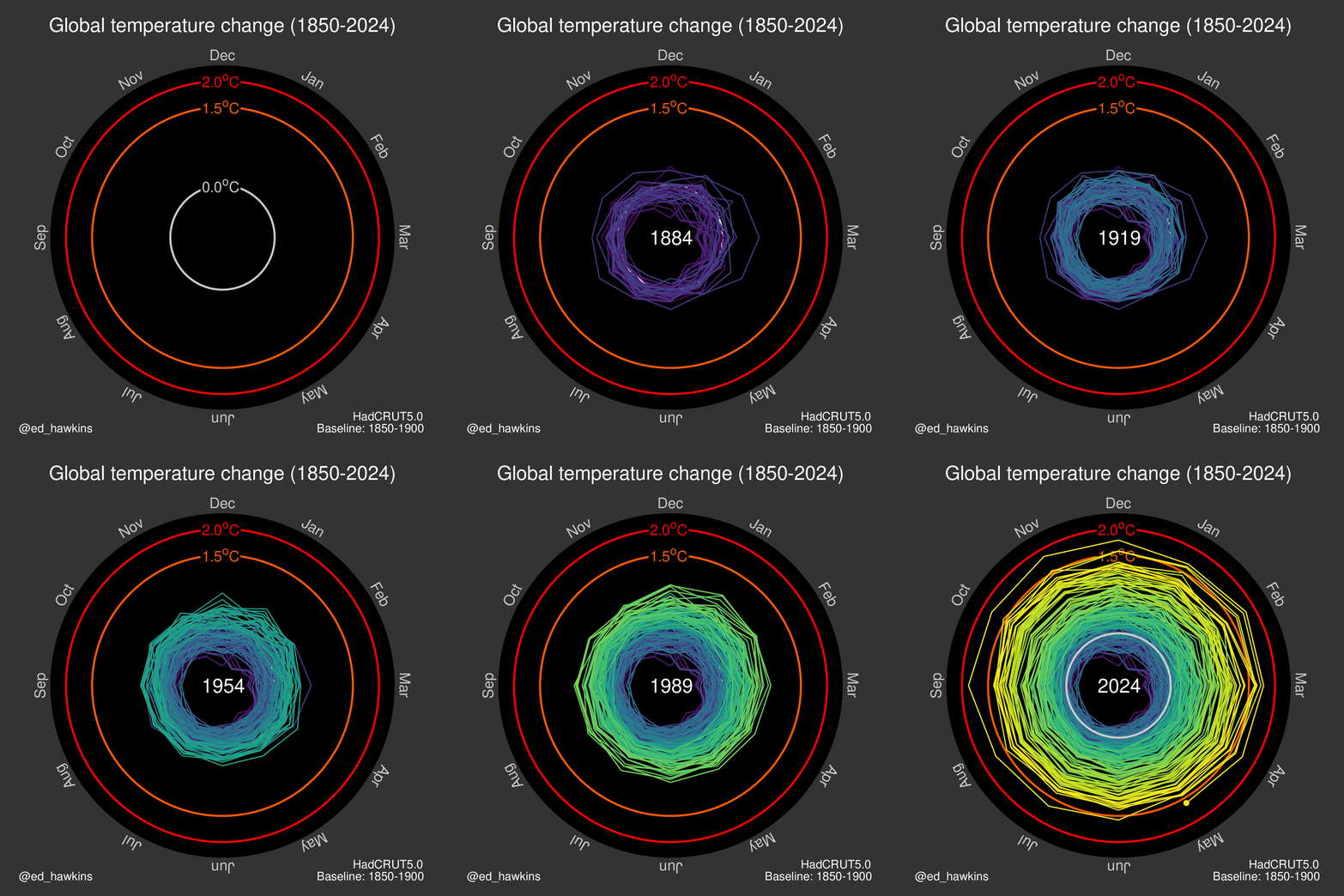
I saw this graphic this week. It achieves its purpose well.
It’s not too late. What if we get it right?
on accompaniment, attentiveness, and contribution
I saw this graphic this week. It achieves its purpose well.
It’s not too late. What if we get it right?
Our sons love to run in a circuit through our apartment. As they do, the younger one loudly reports their movement from “maximum speed!” to “DOUBLE maximum speed” to “TRIPLE MAXIMUM SPEED!”
This is a harmless (so far!) game for them, but for most adults “triple maximum speed” is the uncritically accepted norm of life. We are too often stretched to breaking and do not consider that there is another way. When we do this, we miss the things of greatest value.
These are urgent times we live in… so, let us slow down.
St. Ignatius wrote in annotation 22 of the Spiritual Exercises that “every good Christian ought to be more eager to put a good interpretation on a neighbor’s statement than to condemn it.”
What is on offer here is to habituate the MGI – the most generous interpretation – which holds the door open for curiosity, learning.
This is difficult. Our brains are wired to scan the world for threats in order to keep ourselves safe. It is possible, though, that true safety may be arrived at only when a big group of us are able to default to the MGI.
When we find polarization in our world (and we all do all of the time), do we engage it such that we might solve the underlying problem? Or do we engage in order to feel morally superior?
This outstanding video frames the question brilliantly.
Attachments to the things that do not satisfy are like this.
Every day is a new opportunity to ask for the grace to let go of the bars and simply walk away.
It’s a ridiculous idea, right?
The whole point of a poem is to slow down, savor the beauty of the words, and allow the meaning to emerge.
And yet, are we not often guilty of “speed reading” the best part of our lives? The people we have been given to love. The wonder of the natural world. The delightful complexity of our interior lives and our walk with God.
Let’s pray for the grace to read slowly.
The easy problems are all taken. That leaves the hard ones.
What an opportunity!
So, yes, the solution to the hard problem you have taken on is not immediately in sight.
But what is the next move? And once you move there, what can you see now that you could not see before?
Clarity may come once you move into the possibility adjacent to your current position.
Have you heard “You Can’t Make Old Friends” lately? The journey that the first two lines can take us on is worth the click.
Maybe I love the song because an old friend of mine loves it, but I think there is something more.
I think it represents one of the gentlest memento mori moments around, reminding us to consider what is most valuable to us and that we do not get forever to cultivate and delight in those relationships.
We move back to the United States this coming week.
Some weeks ago, a friend asked why we were leaving Germany. I told him that our tour was only two years, and those years are wrapping up.
“Ah,” he said, “so you knew from the beginning that it was all time-bound.”
I liked how he put that, and have thought about it the days since. It is true of our time in Germany, and it is true of our time on the earth.
We know from the beginning that our whole lives are time-bound. We don’t get forever here.
While I can appreciate this intellectually, I don’t feel that I really comprehend and internalize it until I am confronted with the pain of it.
Such a moment happened this week, when I was told of the death of a friend and mentor. Fr. Tom McDermott, CSC had just shy of 74 years to teach those who had the privilege of learning from him that liberating reality that the truth will make you strange. This week, I am internalizing the loss of him and will write more next week appreciating the remarkable human that he was.
The Ministry for the Future is a “climate fiction” novel that compellingly “plays forward” climate change. (The book was published in 2020, and the plot begins in 2025.)
The action centers around the “Ministry for the Future,” a global organization that advocates for future generations.
It is an ultimately hopeful book, that is also heart-breaking and life-changing.
Every human being should be offered a copy and encouraged to read it.