The Mastery Response Narrative

When I was coaching teachers, the centerpiece of writing a good lesson plan was called the “Mastery Response Narrative” (or MRN).  It was the narration of how one arrived at the completion of the task to be mastered.

So, take a simple example: Say, in Spanish class, the students were to learn how to conjugate a regular “-ar” verb.  

The “target task” to be mastered would be: “Write ‘I speak’.”

The “mastery response” would be: “Yo hablo.”

And then the MRN: “I know that the infinitive of “to speak,” in Spanish, is “hablar” which is a “regular” verb… the base form of the verb does not change when I conjugate it.  And the first person (Yo) verb ending is “-o.”  So to conjugate it, I remove the “-ar” from “hablar” and place the “-o” on the end of the root (“habl-”) to make “hablo.”  Then I add the first-person pronoun (Yo) to form Yo hablo…”

Ok – so kiiind of tedious for a simple task. 

But!  The MRN is indispensable for the teacher-in-training as they are welcomed back into a “beginner’s mind” for the task at hand.  The teacher also sees, through the MRN, all of the steps that they must help the students to practice in order to master the task.

I’ve been thinking about the MRN as I think about less straight forward tasks that we desperately need to master.

How can a busy person cultivate solitude?

How can someone build empathic relationships with people who think much differently than they do?

How can an individual connect with others to address climate change?

How can someone who wants to follow Jesus not become lukewarm or discouraged or a hypocrite and follow the Master anew each day?  

For whatever challenge we want to master, we might seek a person who is thriving at this challenge despite having similar constraints as we do.  Then, ask them for their MRN… How did they come to master this challenge?  And then sit and listen.

Any invitation for someone to give their MRN opens up a series of gifts.  The person you admire begins to see themself as a teacher.  (Gift!)  And you get a narrative to emulate and share.  (Gift that keeps on giving!)

One final thought: What have you mastered that we desperately need you to share about?  Consider doing an MRN today and see how much you have to teach.  You may be the one we’ve been waiting for.
Seeing as Though Our Life Depends on It

Everyone has someone with whom it is difficult to get along.

What if we were to live as though this person holds the key to some knowledge that our life depends on? What if we knew we would learn a crucial lesson if we could just quiet the story about them in our heads long enough to actually see them in their fullness?

I believe that our life together *does* depend on this type of seeing.

It’s time to get curious about that person and to learn something through the process.

Small Stories

Solitude allows us to slow down and consider how very small and needlessly complicated are many of the stories we rehearse within our heads.

(“Small” and “complicated” seem, at first glance, to be opposites, and yet, that is exactly what these unworthy stories are.)

Letting go of these stories frees us to receive the gift of the story of how profoundly we are loved.

The Final Freedom

Viktor Frankl named “the last of the human freedoms” as the ability “to choose one’s attitude in any given set of circumstances… to choose one’s own way.” (Man’s Search For Meaning)

And, of course, he has serious authority.  This assertion was made as he reflected on his time in four different concentration camps.

His point is universally important and applicable: how we face the day is a deeply moral and creative act.  

Every moment offers us the possibility to change the story to be more constructive, more loving, more curious.

The Silent Request

I am rereading the remarkable Religious Potential of the Child, and was stopped short by this sentence which begins the third chapter.

“The adult who accepts the silent request of the child: “Help me to come closer to God by myself,” must choose the way to give the child the help [he or she] asks for.” (page 33)

Whoa!

And, I wonder if this is actually the silent request of all to show up in a given faith community.  

What would it mean to prioritize attentiveness to this longing?  How would the church change?

I think we would become like a network of spiritual directors, with individuals becoming deeply curious about the silent request of their neighbor and responding with excellence to it.

Free Will

In college, I recall discussing “human free will” as a sort of a given, an endowment that we are born with, like our bones and muscles.

The mystics and behavioral economists, though, show us that this is hardly the case.  The freedom of our will is only a potential within us and something that, with grace and intentional work, we can slowly actualize.  

That is, so much of what I think are “my actions” are only reflexive reactions, based on my mental and physical makeup, my past conditioning, my environment.  I have been programmed, by nature and by nurture, to do certain things.  The path to freedom, then, consists in accepting the (occasionally brutal) grace of seeing the particulars of this reality, and accepting this “learning to see” as a daily process and discipline.  

Then, when we are able to love in ways that do not compute, we can know that we are on the path of freedom.

What’s Working?

No life is free of constraints.  Time is limited.  Environment is limiting.

It is not a worthwhile use of this limited time to fixate passively on these limitations and blame our problems on them… because someone with our same constraints is thriving despite them.

Getting curious about what is working for that person or group just may get us unstuck and back on the road where we want to go.

Each Day, Fresh Eyes

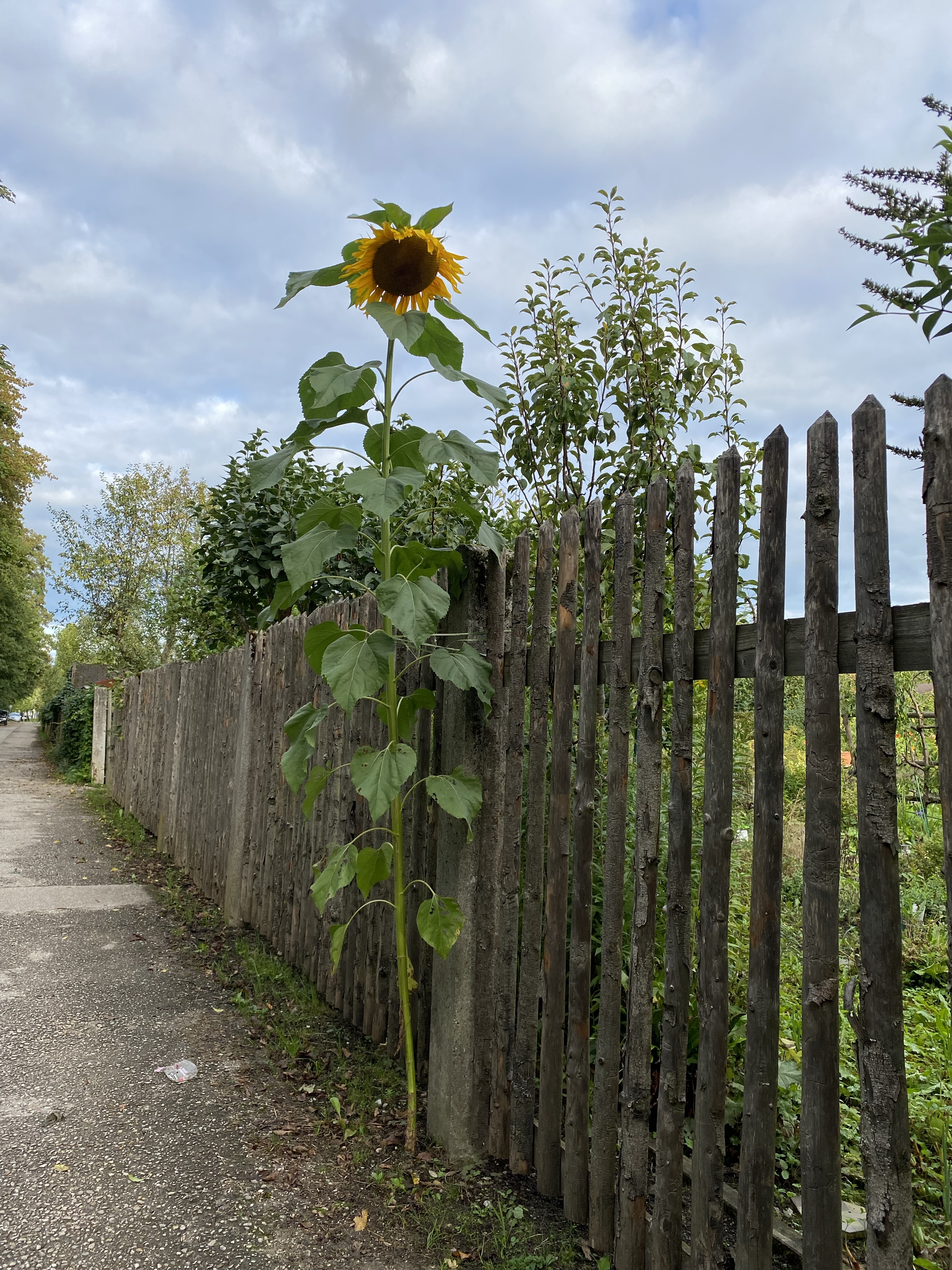
Our sons love this sunflower (below) that has sprung up just outside the fence of a community garden near our home.

Each day, they ask to check up on this flower (both to and from school) so they can see if it has changed.

I bored quickly of this game, until I realized that, once again, they were teaching me how to love.

They are ready, every day, to see this flower with fresh eyes.  

Similarly, we simply cannot love (a partner, a child, a plant) if we do not approach them with the same openness and freedom.  We are able to love only that which we can constantly discover anew.

The Examen Book Turns One

The Examen Book is turning one!  It’s a wonder how fast these kids grow up.  And what a way to celebrate the year… … a Loyola press webinar roundtable this week on the Examen prayer with three formidable interlocutors – Becky Eldridge, Jim Manney, and Fr. Mark Thibodeaux, SJ.  Here is the recording.  If youContinue reading “The Examen Book Turns One”