Brave Spelling

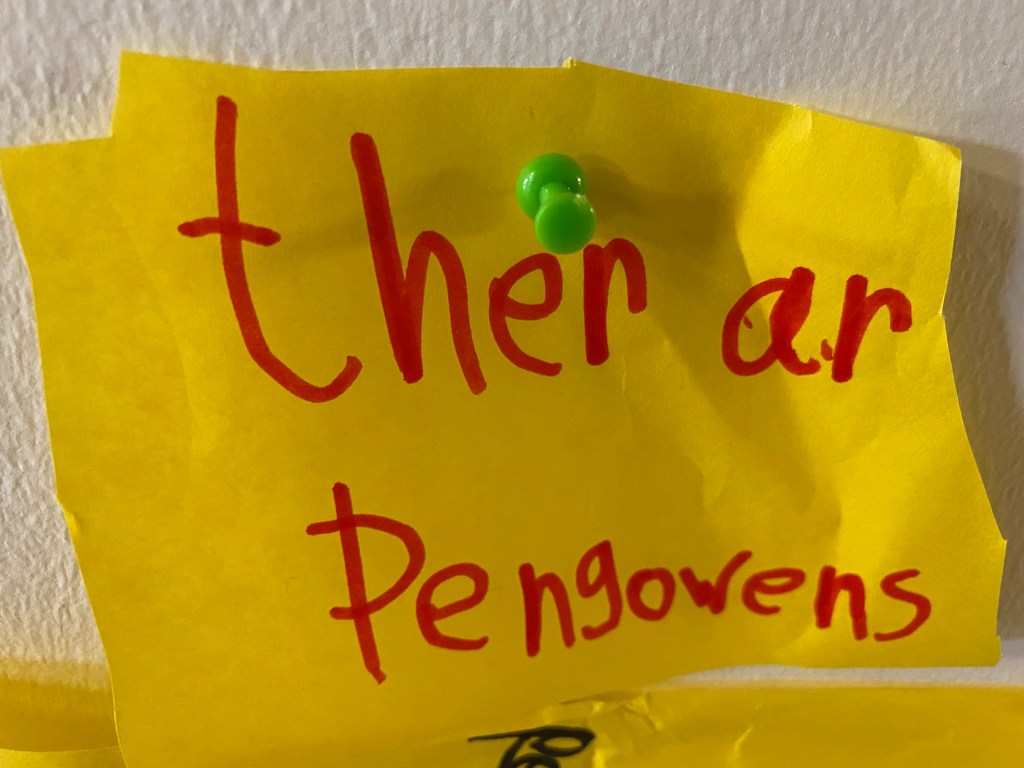
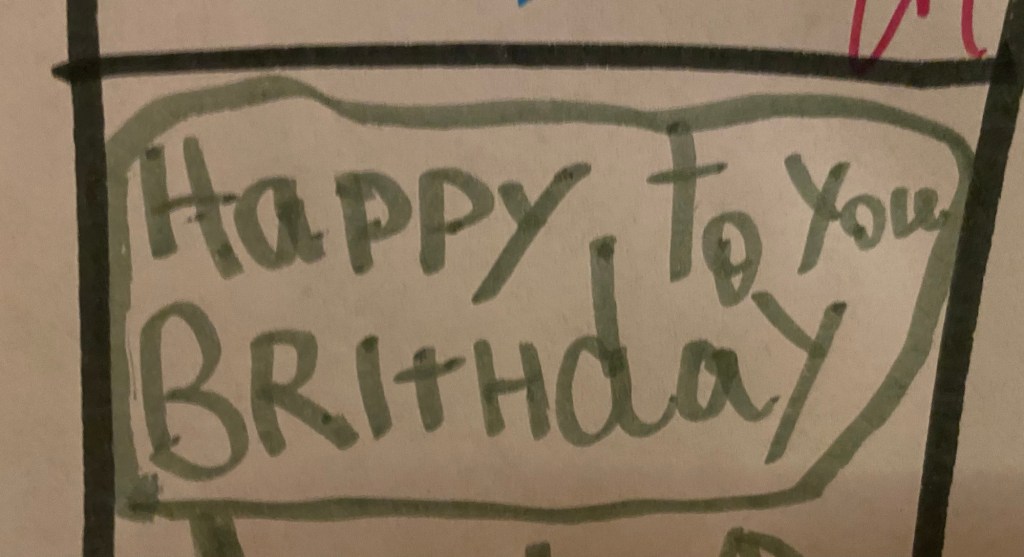
Our first grader is learning to read and write.  As he practices writing, his school teaches an approach known as “brave spelling.”  That is, he is encouraged to sound out a word and spell it as best he can.  He is to articulate his thoughts knowing that they will not be written perfectly.  

Here is an example:

He makes mistakes, sure, but this approach frees him to communicate on a surprisingly high level for someone who has just begun to write.  And his spelling actually improves in the process of imperfect articulation.

Something similar happens as we learn to articulate our interior lifes… to a loved one, in spiritual direction, in prayer.  Of course we will make mistakes as we perceive and share our deepest longings.  But in the attempt (and as we ask for the grace to see clearly) our “spelling” will improve. This is a process that continues our whole lives.

Put a different way, if we do not bravely work to articulate our interior lives, I’m not sure we grow much.  

“Perfect” is neither possible nor is it the aim.  And if we wait for “perfect,” we will never say what needs to be said.

But Not Yet

Remember St. Augustine’s insightful (and quite humorous, really) quote in The Confessions?  

“Lord, make me chaste, but not yet.” (emphasis added)

It’s a wonderfully pithy articulation of that human capacity to hold back from the goodness that we might become.

And of course it applies to anything that takes courage and initiative… that thing that we mean to do, but have just not got around to it.

The momentum of the new year is a great time to push past the “but not yet.”

The Value of an Education

As we graduated from college, Fr. Ted Hesburgh remarked to our class that one way to assess the value of one’s education was to look at the books one is reading, 10, 20, and 30+ years on.

What are you reading these days?

(And as 2024 begins, a great question to ask someone you admire is: What should I read next?)

Brain Kryptonite

Recently, I read a study finding that two things wildly diminish our brain power.

One was notifications (ding!) from a smart phone (or computer applications or whatever).

The other was moral outrage.  (Which is different from being principled, generous, and willing to engage the world…)

And it makes sense, right?  The former fragments the attention until it is difficult to focus deeply.  And the latter cuts the roots off of our curiosity.

Beware the brain’s kryptonite.

The Good Apples

In The Culture Code, Daniel Coyle describes that, far and away, the most productive, cohesive, and enjoyable groups have a member that is a “good apple.”

“Good apples” maintain stability and safe connection among the members of the group, so that group energy can focus on doing the work instead of (often anxious) relationship management. With small behaviors, they defect negativity and drain danger from the room.  By subtly communicating that the group is safely connected, they create the conditions for others to perform.

We have each known these good apples, and they are marvelous to work with.

Being a “good apple” takes a certain amount of emotional intelligence and social skill, but it is also a generous choice.

The Mastery Response Narrative

When I was coaching teachers, the centerpiece of writing a good lesson plan was called the “Mastery Response Narrative” (or MRN).  It was the narration of how one arrived at the completion of the task to be mastered.

So, take a simple example: Say, in Spanish class, the students were to learn how to conjugate a regular “-ar” verb.  

The “target task” to be mastered would be: “Write ‘I speak’.”

The “mastery response” would be: “Yo hablo.”

And then the MRN: “I know that the infinitive of “to speak,” in Spanish, is “hablar” which is a “regular” verb… the base form of the verb does not change when I conjugate it.  And the first person (Yo) verb ending is “-o.”  So to conjugate it, I remove the “-ar” from “hablar” and place the “-o” on the end of the root (“habl-”) to make “hablo.”  Then I add the first-person pronoun (Yo) to form Yo hablo…”

Ok – so kiiind of tedious for a simple task. 

But!  The MRN is indispensable for the teacher-in-training as they are welcomed back into a “beginner’s mind” for the task at hand.  The teacher also sees, through the MRN, all of the steps that they must help the students to practice in order to master the task.

I’ve been thinking about the MRN as I think about less straight forward tasks that we desperately need to master.

How can a busy person cultivate solitude?

How can someone build empathic relationships with people who think much differently than they do?

How can an individual connect with others to address climate change?

How can someone who wants to follow Jesus not become lukewarm or discouraged or a hypocrite and follow the Master anew each day?  

For whatever challenge we want to master, we might seek a person who is thriving at this challenge despite having similar constraints as we do.  Then, ask them for their MRN… How did they come to master this challenge?  And then sit and listen.

Any invitation for someone to give their MRN opens up a series of gifts.  The person you admire begins to see themself as a teacher.  (Gift!)  And you get a narrative to emulate and share.  (Gift that keeps on giving!)

One final thought: What have you mastered that we desperately need you to share about?  Consider doing an MRN today and see how much you have to teach.  You may be the one we’ve been waiting for.

Audacious Ignatius, Adopted

Five years ago this week, Audacious Ignatius was born.

With joy, gratitude, and lots of mailing tape, I packed up all these boxes on our kitchen counter and brought them to the local post office to share with folks who believed in the project from the moment we shared it on Kickstarter.  

And what a brilliant first five years it has been… What has made this project so rich is the partners and companions that generously lent feedback and enthusiasm to the effort of sharing the book.  

And so we are delighted that Audacious Ignatius has been adopted by Loyola Press, so that we can share the book more widely and efficiently.

Audacious Ignatius is now available at Loyola Press’ website and (for the first time!) on amazon.com.

Thanks, as always, for being a part of our books’ journeys.

Seeing as Though Our Life Depends on It

Everyone has someone with whom it is difficult to get along.

What if we were to live as though this person holds the key to some knowledge that our life depends on?  What if we knew we would learn a crucial lesson if we could just quiet the story about them in our heads long enough to actually see them in their fullness?  

I believe that our life together *does* depend on this type of seeing. 

It’s time to get curious about that person and to learn something through the process.

Small Stories

Solitude allows us to slow down and consider how very small and needlessly complicated are many of the stories we rehearse within our heads.

(“Small” and “complicated” seem, at first glance, to be opposites, and yet, that is exactly what these unworthy stories are.)

Letting go of these stories frees us to receive the gift of the story of how profoundly we are loved.

The Final Freedom

Viktor Frankl named “the last of the human freedoms” as the ability “to choose one’s attitude in any given set of circumstances… to choose one’s own way.” (Man’s Search For Meaning)

And, of course, he has serious authority.  This assertion was made as he reflected on his time in four different concentration camps.

His point is universally important and applicable: how we face the day is a deeply moral and creative act.  

Every moment offers us the possibility to change the story to be more constructive, more loving, more curious.