The Keynote Listener

We have all been to events with a keynote speaker. A recognized expert in a subject is given time to inform or inspire.

It is a known meeting structure. The speaker has the microphone. We sit and listen.  

Last week, I talked to a group that does things differently.  They organize gatherings around a keynote listener. (Very cool!) 

The keynote listener is a recognized expert in creating a gathering in which other people feel comfortable sharing their experience and wisdom. The keynote listener listens at this gathering, and then at the end of the meeting, synthesizes and summarizes so that the whole group can benefit from the wisdom of the group.

Are you a part of a group that could benefit from a keynote listener?

Cynicism is a Choice

And it’s a bad choice.

Clear-eyed and truth-seeking, yes, but not cynical.

Cynicism accepts and reifies the worst parts of the status quo. It paralyzes us and wastes our energy by focusing on things we cannot control.

And it subtly lets us off the hook.  (“Look at those people over there who are the problem.  Nothing I can do about it.”)  The cynic barricades themselves on the moral high ground and feels superior while contributing little.

The cynical mindset forgets that we are all capable of evil and all caught up in a system where it is often hard to do good.

The alternative is to be people with hope to bring – to see the world as it is, and, from there, to love and lead. 

Opportunity and hope are everywhere, but cynical eyes cannot see them.

The Suscipe’s Nouns

In the Suscipe prayer, one offers to God four things without reservation: one’s liberty, understanding, memory, and will.

People who do this consistently have always been remarkably valuable to the communities of which they are a part.  They are teachers of what is ultimately valuable, lights on the path of where we are to go.

In our present world, the value of this asset is on the rise.

Consider the Suscipe’s nouns in an age of AI.  Even the models available now are potentially massive aids to our understanding and memory, and they are only going to get better.  Imagine having a brain prosthesis to help you recall and utilize everything you have ever written or read.  With some set-up, this is more or less available now.

But also the risk of losing one’s way is significant.  The digital world is going to get better and better and acting like it knows us.  (It doesn’t.)  This faked understanding will help the Dopamine Cartel* (social media, etc) fragment and sell our attention to the highest bidder, with obvious implications for liberty and will.

The opportunity is clear: Every day, we can offer our liberty, understanding, memory, and will to the Mystery of God.  We can be rooted, or we can be uprooted.

*I borrowed this outstanding metaphor from this blog post.  The dopamine talk starts about a third of the way down the page.
A Joyful Announcement (And a Humble Request)

I am delighted to announce that Sorin Starts a School has been officially adopted by Ave Maria Press.  It is now available on their website and on Amazon.

We are thrilled to partner with a ministry of the Congregation of Holy Cross on a book that foregrounds their charism.

And might I hazard a request of your time today?  In the world of Amazon, a lot hinges on the number of reviews for a given book.  Might you click through and write up a short review today?

(If you don’t have your copy handy, I’ll take a minute to read it to ya. :D)

Remote Control

Our boys enjoy the occasional “what if” game. The other day our older son asked, “what if you could *only* move when someone told you to move?!”

His brother then began to “control” his movements with his speech.  And if his brother didn’t tell him to move, then he was stuck.

If we are attached to the approval of others, our actions are bound in a similar way.  We are subject to either manipulation or paralysis.

Far better to root in something real.

Majoring in the Minor

It is possible to not realize that we spend a disproportionate amount of our energy on things of little consequence. When we do, we major in the minor.

We do this with our health when we obsess about a dietary detail, but don’t exercise much or give ourselves the chance to sleep well.

At work this can happen when we clamp down on a problem the resolution of which will not actually move us forward.

And then, with limited time left, we minor in the major.

The tricky part is that majoring in the minor feels like we are doing something productive. We are not.

Let’s major in the major.

Attention Intention

Every day, our children notice what captures our attention. They take outstanding inventory of our focus and so come to know what we value.

Realizing just how much they understand helps me become better than I might otherwise be. Principally, this entails decreasing the number of things that I try to pay attention to.

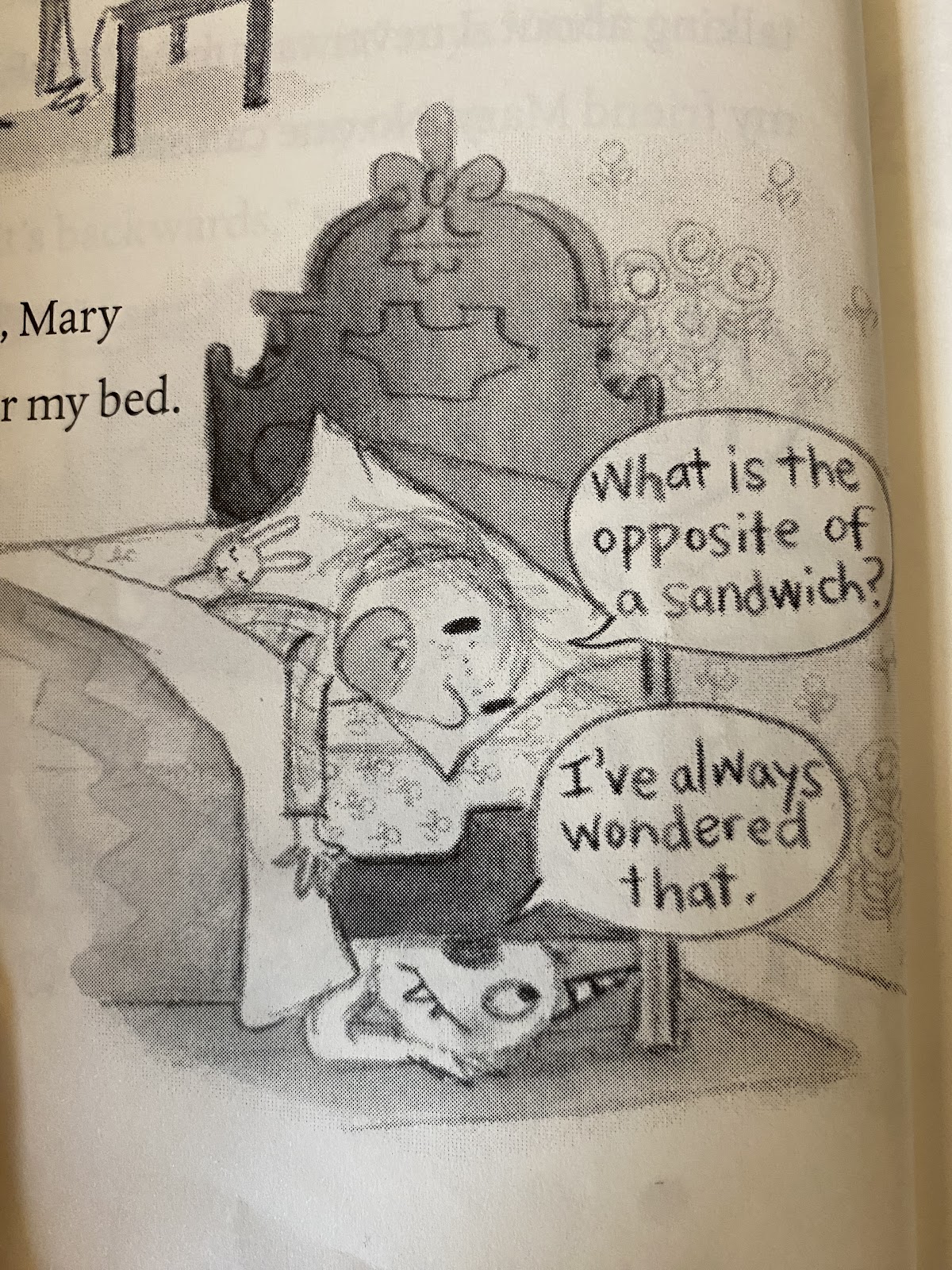
The Opposite of a Sandwich

When we enter the world of Maurice Sendack, Fred Rogers, Roald Dahl, Mo Willams, or the geniuses who write and produce Bluey, we know instinctively that we are in the hands of special people.  

They have clearly cultivated a special attentiveness to children and then create a world rooted in this tender perception that invites all to rejoice in a child’s way of proceeding.

Our boys have stumbled upon another writer with this same gift.

Abby Hanlon’s Dory Fantasmagory is a delight for all comers, especially sassy younger children who may feel a little left behind by older siblings.

The fifth book in the series is our favorite, but we are re-reading them all to make sure.

The Value of Discomfort

The most valuable things reside on the other side of discomfort.

The vulnerability of commitment.

Sharing something that is deeply important to us with another.

Taking the first awkward steps to learn a new skill set.

Sitting in quiet non-judgemental awareness with one’s own mind.

These moments can be quite uncomfortable… but if we are able to see this discomfort as something enormously valuable, then we are able to grow.

Sandra Boynton and the Necessity of Birthday Cakes

Our younger son just turned five, so we do not reach for the Sandra Boynton volumes much these days.

Still, I often recall my indebted to Ms. Boynton’s work, especially for this gem of an essay published in 2021, around a year into the pandemic.

I find it, as a parent (and especially as a parent who can sometimes undervalue a thing like a birthday cake), to be an essential reorientation around “what is essential.” 

So, parents, thanks for the work that you do, especially in the provisioning of light-heartedness in the life of your littles.