In college, we used to jokingly talk about “the DTR”… where two people, with unspoken interest in a romantic relationship need to take time to “define the relationship.”
It’s a great turn of phrase and a useful tool.
It is worth it, too, to periodically have a DTR with one’s practice of religion.
That is, does my practice of religion:
Pad my ego and sense of superiority?
Narrow what I am willing to see?
Or does it represent a humbling preparation to enter a mystery of love, to engage a life more abundant than we could have imagined or engineered?
Talking about fixing problems… is not the same as actually addressing them.
Yes, talking about strategy is important. It should also not be confused with the action, the actual fixing.
Here may be the hard part: Talking about a problem, finally getting it out in the open can feel good. A sense of relief follows. But if we let the tension of the moment drain all the way out, we will never do the thing we said we would do.
Mistakes were made (but not by me) is a delightfully devastating book chronicling the human tendency to avoid responsibility, to self-justify, to make ourselves look good.
Seen in one way, it lays bare our compulsion to try to control our own sense of goodness.
Holiness, by contrast, consists in coming to realize that:
(1) we are, truly, not any better than anyone else and are quite capable of petty and destructive behavior.
(2) we are, in fact, very, very good… much more so than we could ever manufacture by ourselves, and that unique goodness is a wildly extravagant gift.
Seeing this frees us to avoid the exhausting dead end of a life lived out of the “mistakes were made but not by me” mantra.
So freed, we are able to see that (and talk about how) we participate in a system that is not functioning as well as it could. And then we can ask: “How can I help?” “How can I show up in generosity, bravery, and love to participate (better) in this system?”
The answer to these questions may likely consist in doing less things, but seeing more deeply.
From September 1940 until the following May, in a period called “the Blitz,” German bombers dropped thousands of tons of explosives on the city of London.
Eight million Londoners moved in shelters and subway stations to avoid the destruction of these raids.
And from that time, there is data to suggests that mental health in London improved.
“Not only did these experiences fail to produce mass hysteria, they didn’t even trigger much individual psychosis. Before the war, projections for psychiatric breakdown in England ran as high as four million people, but as the Blitz progressed, psychiatric hospitals around the country saw admissions go down. Emergency services in London reported an average of only two cases of “bomb neuroses” a week. Psychiatrists watched in puzzlement as long-standing patients saw their symptoms subside during the period of intense air raids. Voluntary admissions to psychiatric wards noticeably declined, and even epileptics reported having fewer seizures. “Chronic neurotics of peacetime now drive ambulances,” one doctor remarked. Another ventured to suggest that some people actually did better during wartime.”
So, certainly, the paragraph above does not describe everyone’s experience of violence. War is not a good time.
It does make me think, though, that meaningful, communal struggle actually does make us happier, in the long run, than lives oriented around individual comfort.
Instead of constantly rearranging our lives to make them more pleasant, let’s seek lives of responsibility and active love.
My life is blessed with ample evidence of the depth of the interior life of children, and I know that I want to center the recognition of this reality in my life. And yet! It is easy for me, in the daily churn, to forget this depth and / or to act like I haveContinue reading “Children Are Capable of Depth”
Have you ever seen one of those cable news finance shows with the stock ticker running on the screen? They are tough to watch for any length of time. There is a LOT of information (paired with emotion-laden narratives spun from that information).
XYZ is up! (But for how long!?)
ABC is down! (Catastrophe! And then HIJ said this thing about LMNOP!)
Sometimes, we do a similar thing with our inner lives, “ticker watching” how happy we are at any moment. We survey and analyze everything that happens through this narrow “happy” lens until we are so exhausted we cannot find the happiness we sought in the first place.
Better to suspend this hyper-analysis, orient our interior life to a longer time horizon, and live more deeply into the experience of active love.
This will lead to places that do not look “happy” at first glance, but ultimately to a deeper joy, more durable contentment, and lasting peace.
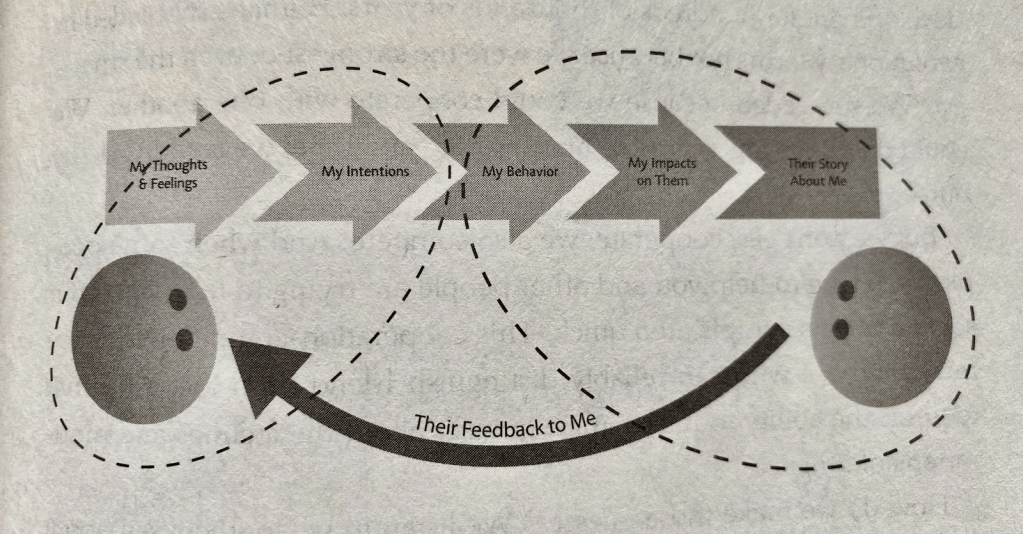
It is a diagram of what is happening when we do something and someone reacts to it. Pretty basic interaction, right?
Not at all! It is so complicated!
It turns out, that it is remarkably difficult to see our behavior (and the impact that it has) objectively.
Yes, we ideally have access to what is inside the left-hand, smaller circle… “my thoughts & feelings” and also “my intentions,” though even these are not always accessible to us depending on our inner state!
And then, we have partial knowledge of our behavior… partial because it is so hard to perceive our facial expressions, body language, and tone of voice.
And unless the other person chooses to share, we have no visibility on the things solely in the right-hand circle: “my impact on them” and “their story about me.” These form the basis of their feedback.
Our relationships (and so our life) get better when we have more visibility on our behavior and our impact on others.
So, where to start?
1. Mindfulness practice – This deepens and refines my perception of and receptivity to all of the inputs in the graphic.
2. Taking myself less seriously – Humor (particularly the self-deprecating kind) lowers the stakes for the person who might take the risk to clue us in on what we are missing.
 Paul's Blog