The Good Apples

In The Culture Code, Daniel Coyle describes that, far and away, the most productive, cohesive, and enjoyable groups have a member that is a “good apple.”

“Good apples” maintain stability and safe connection among the members of the group, so that group energy can focus on doing the work instead of (often anxious) relationship management. With small behaviors, they defect negativity and drain danger from the room.  By subtly communicating that the group is safely connected, they create the conditions for others to perform.

We have each known these good apples, and they are marvelous to work with.

Being a “good apple” takes a certain amount of emotional intelligence and social skill, but it is also a generous choice.

The Mastery Response Narrative

When I was coaching teachers, the centerpiece of writing a good lesson plan was called the “Mastery Response Narrative” (or MRN).  It was the narration of how one arrived at the completion of the task to be mastered.

So, take a simple example: Say, in Spanish class, the students were to learn how to conjugate a regular “-ar” verb.  

The “target task” to be mastered would be: “Write ‘I speak’.”

The “mastery response” would be: “Yo hablo.”

And then the MRN: “I know that the infinitive of “to speak,” in Spanish, is “hablar” which is a “regular” verb… the base form of the verb does not change when I conjugate it.  And the first person (Yo) verb ending is “-o.”  So to conjugate it, I remove the “-ar” from “hablar” and place the “-o” on the end of the root (“habl-”) to make “hablo.”  Then I add the first-person pronoun (Yo) to form Yo hablo…”

Ok – so kiiind of tedious for a simple task. 

But!  The MRN is indispensable for the teacher-in-training as they are welcomed back into a “beginner’s mind” for the task at hand.  The teacher also sees, through the MRN, all of the steps that they must help the students to practice in order to master the task.

I’ve been thinking about the MRN as I think about less straight forward tasks that we desperately need to master.

How can a busy person cultivate solitude?

How can someone build empathic relationships with people who think much differently than they do?

How can an individual connect with others to address climate change?

How can someone who wants to follow Jesus not become lukewarm or discouraged or a hypocrite and follow the Master anew each day?  

For whatever challenge we want to master, we might seek a person who is thriving at this challenge despite having similar constraints as we do.  Then, ask them for their MRN… How did they come to master this challenge?  And then sit and listen.

Any invitation for someone to give their MRN opens up a series of gifts.  The person you admire begins to see themself as a teacher.  (Gift!)  And you get a narrative to emulate and share.  (Gift that keeps on giving!)

One final thought: What have you mastered that we desperately need you to share about?  Consider doing an MRN today and see how much you have to teach.  You may be the one we’ve been waiting for.

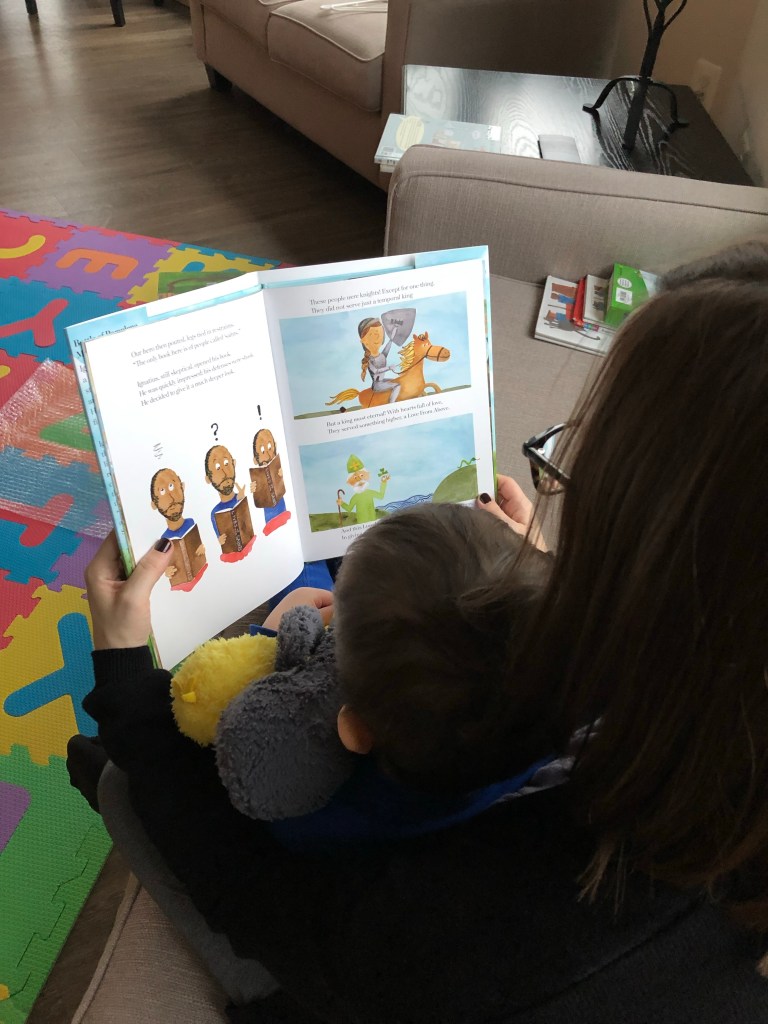
Audacious Ignatius, Adopted

Five years ago this week, Audacious Ignatius was born.

With joy, gratitude, and lots of mailing tape, I packed up all these boxes on our kitchen counter and brought them to the local post office to share with folks who believed in the project from the moment we shared it on Kickstarter.  

And what a brilliant first five years it has been… What has made this project so rich is the partners and companions that generously lent feedback and enthusiasm to the effort of sharing the book.  

And so we are delighted that Audacious Ignatius has been adopted by Loyola Press, so that we can share the book more widely and efficiently.

Audacious Ignatius is now available at Loyola Press’ website and (for the first time!) on amazon.com.

Thanks, as always, for being a part of our books’ journeys.

The Final Freedom

Viktor Frankl named “the last of the human freedoms” as the ability “to choose one’s attitude in any given set of circumstances… to choose one’s own way.” (Man’s Search For Meaning)

And, of course, he has serious authority.  This assertion was made as he reflected on his time in four different concentration camps.

His point is universally important and applicable: how we face the day is a deeply moral and creative act.  

Every moment offers us the possibility to change the story to be more constructive, more loving, more curious.

Turning Two

Sorin Starts a School is turning two!  

It’s been a pretty fun two years, making connections with communities for whom the book is a gift and receiving the news of its Moonbeam award.

To celebrate, we’ve made a curriculum guide for Sorin Starts a School in order to make it easier for educators at Catholic schools and parishes to plan lessons that lead to the heart of our tradition and to the charism of the Congregation of Holy Cross.  

Here is the link to download the guide. Please share it with your educator friends!

And below is an intro video for the guide.

What’s Working?

No life is free of constraints.  Time is limited.  Environment is limiting.

It is not a worthwhile use of this limited time to fixate passively on these limitations and blame our problems on them… because someone with our same constraints is thriving despite them.

Getting curious about what is working for that person or group just may get us unstuck and back on the road where we want to go.

The Examen Book Turns One

The Examen Book is turning one!  It’s a wonder how fast these kids grow up.  And what a way to celebrate the year… … a Loyola press webinar roundtable this week on the Examen prayer with three formidable interlocutors – Becky Eldridge, Jim Manney, and Fr. Mark Thibodeaux, SJ.  Here is the recording.  If youContinue reading “The Examen Book Turns One”

Slack in the System

It can be tempting to maximize every system to its limit.

To squeeze as much productivity out of our minds and bodies selves as possible…

To be satisfied only with the best (whatever it might be)

To overanalyze every moment to make sure it is producing maximum pleasure…

To take from the earth without regard for ecological limits…

At some point, this is going to break down and we will bear the cost.

And this maximization mindset actually makes us unhappy, pounding our interior lives dangerously thin.

Keeping the slack in life’s systems is a worthy and indispensable discipline.