A Scandalous Bargain

A great book is a scandalous bargain.  

To create such a book, an author must assemble a preliminary distillation of ideas, recognize it as worthy enough to continue, overcome waves of fear and inadequacy, show up day after day to the page to write, scrap what was written, and try again.  They then must subject these (as yet unfinished) thoughts to conversations with interlocutors who offer critique.  This feedback in hand, the writer must then undergo the discipline of considering which bits of critique to integrate and which to let go.

(And all of this assumes as a prerequisite that the person has become someone who makes things.  This is no small feat, and a place to which many would-be creators never arrive.)

But when a wise person succeeds in doing all this and offers us a great book, the experience of it is like nothing else.  

Take Consolations, for example.  For me, working through each tiny chapter is like being bowed to by an ancient fighter, then being decisively overpowered, pinned to the mat, and offered a hand back up.  The process teaches me what I was not even cognizant that I needed to learn about the experience of living.

It is scandalous that I have access to this distilled experience for the price of one book.

Dreams, Goals, or Systems

I read the following this week:

“You do not rise to the level of your dreams.  You fall to the level of your systems.” (from chapter 1 of this book)

Whoa!  

And, ouch!!

And it might have been “goals” instead of “dreams.” (I was listening to the book while doing dishes, so I didn’t write it down.)  But I think either is true.  

Each moment that we use to simplifying our environment and sharpen our priorities into a habitual system (that gets us where we’ve decided we want to go) is time better spent than waiting for herculean motivation or unimpeachable clarity on the execution of our dreams.

Cathedrals Under Construction

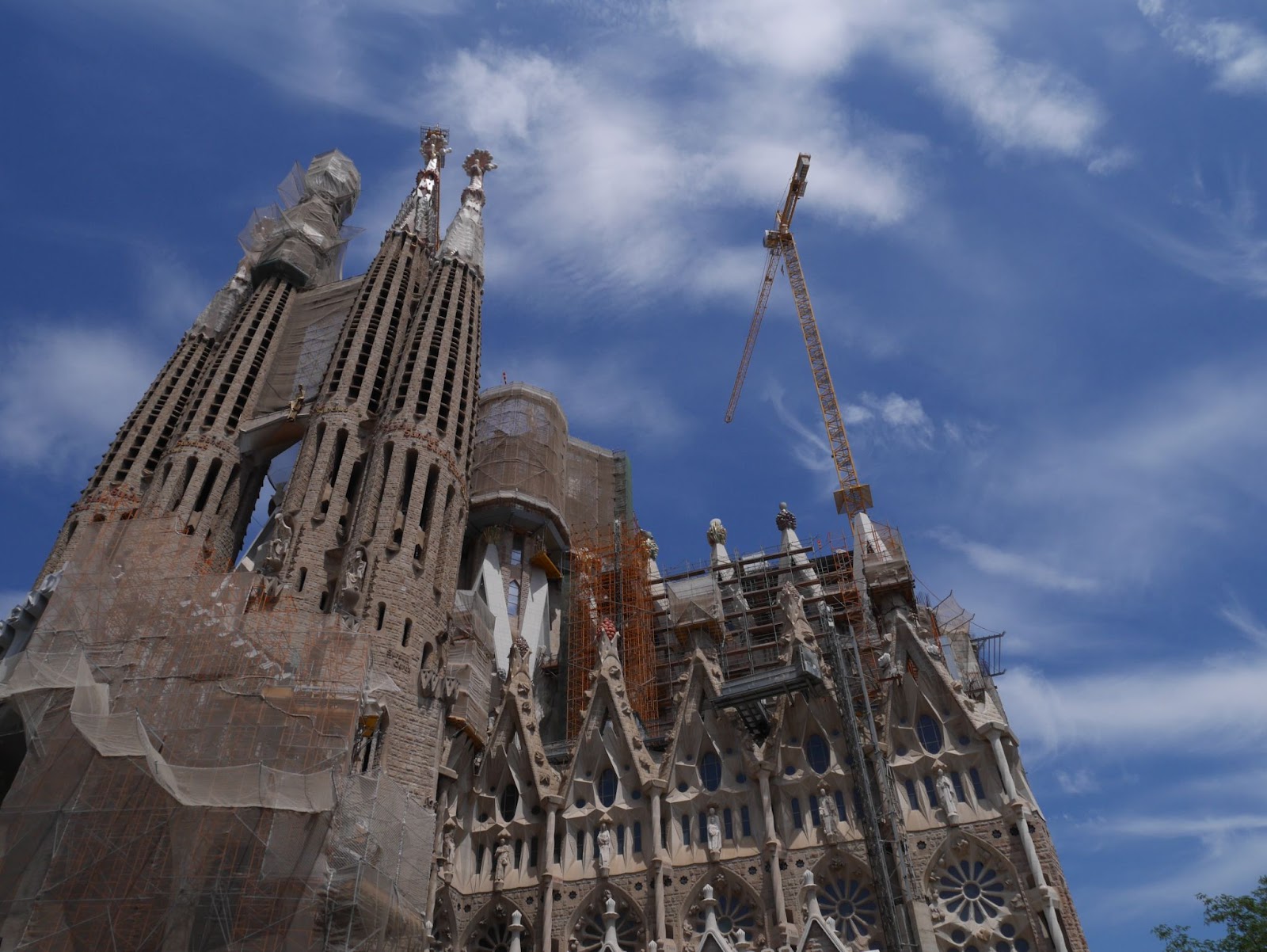
Some years ago, my wife and I spent the day in the Basílica de la Sagrada Familia, pictured below.

The original architect, Antoni Gaudí, hoped the basilica to be “the Bible, made of stone.” Of its uniqueness, one art critic said that “it is probably impossible to find a church building anything like it in the entire history of art.”

These superlative statements are entirely deserved.  Its beauty and layers of meaning were exhausting to take in. 

And what about the crane and scaffolding in the picture? Well, they are still completing construction of the building that was consecrated as a basilica in 2010.

Wait, what?  Unfinished and consecrated?

Yes, indeed!

And so I think it is with us.  

We are also cathedrals under construction – in need of grace and good company to help us to grow and already capable of the participating in the love that is God.  When we are able, with that same grace, to hold our cathedral-ness and our under-construction-ness together, we are capable of unique and remarkable beauty.

The Other Two

A few weeks ago, I wrote about how the daily emails I read went from two to three (when I signed up for The Daily Difference, a source of reliable and easily understandable knowledge on climate change.)

A few people asked me about the other two.  Here they are!

The Daily Meditations from the Center for Action and Contemplation: Most of the meditations are adapted from the writings of Fr. Richard Rohr, OFM.  They translate the depth and challenge of the Christian tradition in a way that is consistently inviting.

Seth Godin’s daily blog: Godin riffs on marketing, empathy, being a human today, and the endurance needed to make a difference.

Most days, I marvel that they give all of this away for free.

And No One Was Thinking About Being a Monster

I hope that you, some day, run into The Monsters’ Monster, a witty, subtle tale about the power of gratitude.

Let’s all, like the Monster, say “dank you” a bit more.

ps – Happy Thanksgiving, all.

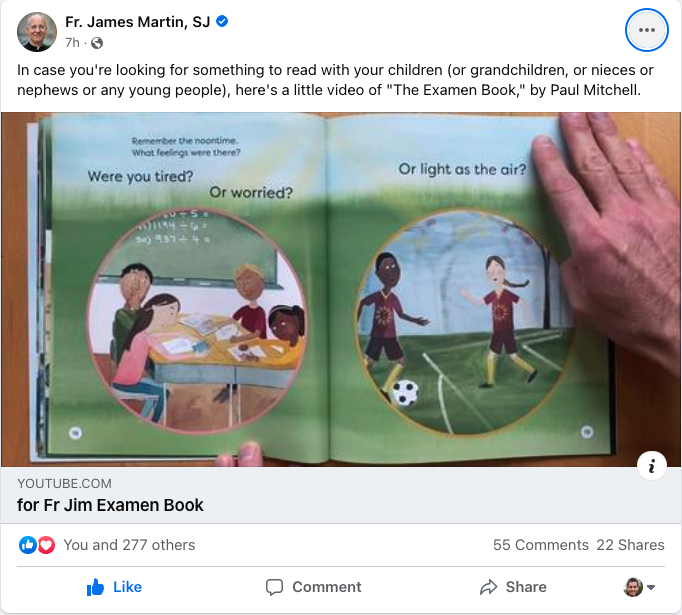
pps- And Katie and I are grateful to Fr. James Martin for this post about The Examen Book.  Thank you, Jim!

People Like Us Do Things Like This

The other day, I saw a car and a bike heading toward each other on the same narrow-ish street. Then I saw the car slow down, pull over, and actually put two tires up on the curb to give the bike more space.

I see similar deference to bikes here routinely. It’s “how things are done around here.”

Sometimes, we are so immersed in the culture of a place or institution that we do not even name or acknowledge the reality of “how things are done.”

But when we slow down and observe (and/or listen to people who are not like us), we see this “how things are done” more clearly. Once we have seen it, we have the choice to consider if this kind of culture contributes to our common flourishing.

If it does not contribute to our flourishing, we can then choose to live and speak a different way.

There is a profound power in the reality of “people like us do things like this.”

Non-Maximization

The principles of Catholic Social Teaching get repeated quite a bit. Human dignity, common good, solidarity, etc. The list usually has seven.

A colleague shared a similar list with me the other day that had eight, and the eighth has had me thinking.

It was the principle of non-maximization, asking us to intentionally leave time unscheduled, land untilled, opportunities on the table. 

Pause for a second to consider how wild (and difficult!) that is for us.

I recently read that St. Francis of Assisi organized that part of their community land was to be left uncultivated so that all could see all what grew there (wildflowers and such), beauty that sprang up without their work.

When we see the wildflowers, it undermines the lie that we are in control as well as the compulsion to be in control.  It leads to a more abundant life.

And where did we get indoctrinated with the opposite (the principle of maximization) anyway?

The Keeper of Slack in the Family System

For years, when I was home full-time with our son (and then sons), I would change up how I answered the question: “So, what do you do?” One day, I heard myself answer: “Well, I am the keeper of slack in our family system.”

And, you know, I kind of liked that title! I began to use it more often and so began to take it more seriously.

I tried to be the keeper of slack *outwardly*, leaving time unscheduled so that I could be present and responsive to family.

I also tried to guard against tension *internally*, building prayer and meditation into my days, hoping to be more attentive and loving.

I must say that I do not feel necessarily accomplished at this guardianship, and definitely less so this year than in years past. But I am still trying, and would love for the “keeper of slack in the family system” to be a common term. It would certainly help me follow through more consistently on this sincere aspiration.

It Is Not Too Late

I am ruthlessly protective of my email inbox, subscribing to nothing that is not (to me) consistently valuable. 

A few months ago, the number of things I subscribe to went from two to three.

I signed up for The Daily Difference, the free email published by The Carbon Almanac Network, a source of reliable and easily understandable knowledge on climate change.  Their tagline is: It is not too late.

It is consistently excellent.  No doom, no guilt, no whipping up negative emotion.  Just fascinating, simple insights about how to care for the earth and then tell your friends.

It consistently fills me with hope, and helps me to believe and to act like it is not too late.