It Is Not Too Late

I am ruthlessly protective of my email inbox, subscribing to nothing that is not (to me) consistently valuable. 

A few months ago, the number of things I subscribe to went from two to three.

I signed up for The Daily Difference, the free email published by The Carbon Almanac Network, a source of reliable and easily understandable knowledge on climate change.  Their tagline is: It is not too late.

It is consistently excellent.  No doom, no guilt, no whipping up negative emotion.  Just fascinating, simple insights about how to care for the earth and then tell your friends.

It consistently fills me with hope, and helps me to believe and to act like it is not too late. 

I Don’t Like That!

When our sons are playing, they often fall out of sync.  One begins playing in a way that the other does not like.  The dissatisfied one, then, expresses his displeasure to us about what the other is doing.

We then say, “Please tell your brother how you do want to play.”

And almost always, he will turn to his brother and, focusing once more on the perceived offense, say, “I don’t like that!”

As you surely have noticed, “I don’t like that!” is not a satisfactory articulation of how he would like to engage.

But how often do we do this very thing in public life!  We are experts at saying what we do not like or do not want, and too rarely take the time to articulate a different way forward.  It feels more comfortable to comment instead of contribute

So, if we do not like something that is happening, let’s agree to do the most courageous and productive thing: To say what we do want and what we will commit to in order to bring that thing about.  With imagination and commitment, we can play together differently.

Earning the Miracle?

Our family is fairly in love with the movie Encanto.  Every time we (routinely) listen to the soundtrack, this bit from the introductory “meet the family” song catches my attention.

It’s when the grandma tells us about how the family can “earn the miracle that somehow found us.”

The trouble, as they all learn, is that we can’t earn a miracle.  

The compulsion to try to earn the miracle of our lives, though, is deeply human and imminently understandable.  If I were to earn it, the logic goes, then I would have some control over it.  And how does my ego love to control!

But the wonder of the sacramentality of our lives… the grace woven through our being, the natural world, our relationships, the unfolding of our vocations… is already ours.  No earning necessary.  It’s taken care of. 

The task, then, is to receive these things whole-heartedly and without pretense, as a child.  So freed, we can respond to this abundance with wild generosity.

Hiding Under the Mess

When our sons can’t find the toy or the book that they are looking for, we’ve learned that the most productive thing to do is to start cleaning up the mess.  When we clean up, we inevitably find the thing we were looking for.

The mess is where things go to hide.

In our church and world, there is plenty of mess.  And by mess, I do not mean conflict.  Conflict can be healthy and will always be with us.  

The mess I mean is what happens when we do not practice empathy on the “other side” of the conflict, choosing instead to whip up the indignation of “our side” against the other.  This failure of empathy creates a mess: layers of wrecked communication, triggered egos, activated amygdalas.  This mess confuses the important issue at hand and barricades us more deeply on our illusory moral high ground.

Too often, the mess is where we go to hide, and almost always unconsciously.  Hide from our own vocation, our own capacity for connection, commitment, and contribution.  

It is far easier to focus on someone else’s mess than to do the hard work we are meant to do.

Holiness, I think, consists in realizing that we are not better than anyone else and all need grace in a profound way.  This humility frees us to begin to clean up the mess and find the love we were seeking in the first place.

Laying Out the Pieces

A few weeks ago, when we were together for Easter, my sister’s son did the following for our older son.

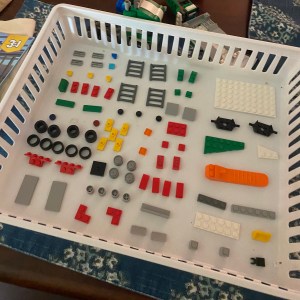
As our son was putting his lego set together, his cousin carefully laid out the remaining pieces.

Good spiritual direction does something similar, I think. From a tangle of experience, a loving director is capable of mirroring back our experience in such a way that invites us into clarity.

The Opposite of Hope

What if we understood presumption to be the opposite of hope?

The presumption that only “we” have anything of worth to say.  That if it is not our truth, then it is a lie.  That truly listening to those people is not worth my time.  That fatalism is the only honest way to face the facts.

Presumption is one way to buffer ourselves from the weight of reality which, considered with clear perception, is quite heavy.  

Hope, though, entails a creative impulse that holds our engagement of reality ajar to love, to courage, and to daily commitment to take charge of the weight of reality.  

I do not think this “hope-holding-us-ajar” movement is something we do on our own, but it is possible to pray for.

Joyful Messengers of Challenging Proposals

In Evangelii Gaudium, Pope Francis writes that we should appear as “joyful messengers of challenging proposals.”*

Proposals, so as to invite others in, open to the next stage of the journey.

Challenging, because that is what our times demand (and an enticing challenge is inherently attractive).

Messengers, because none of us is the Messiah.

Joyful, because we have been deeply loved.

I took a shot at doing just this for a Lenten Retreat at Jesuits.org.  Click the link for the video where I steal my sons’ white board and sketch up a challenging proposal!

*Here is the whole sentence, from paragraph 168: “Rather than experts in dire predictions, dour judges bent on rooting out every threat or deviation, we should appear as joyful messengers of challenging proposals, guardians of the goodness and beauty which shine forth in a life of fidelity to the Gospel.”

The Box on the Board

I once had a teacher do the following.

At the start of class, he walked silently to the board. He slowly drew two parallel horizontal lines, and then connected them into a rectangle with two vertical lines. (By this time, we were all quiet, watching.) He then asked us a question: “What do you see?”

Every answer tried to describe what he had drawn. A box? A TV? A picture frame?

After some time, his response to us was: “Why are you all only talking about these four lines? My question to you was ‘what do you see?’ You could have chosen anything in this whole room, yet you are all fixated here.”

He was right. He had never told us to describe or even look at the rectangle.

The point of the exercise has stuck with me: we allowed what he drew on the board to corral our thinking, to limit our vision and conversation. And this led to the even more important question: how, outside of the class, do we unreflectively allow our vision to be limited?

If we allow [insert dominant cultural narrative] or [insert news outlet] or [insert social media platform] or [insert cultural turf battle] to frame our thoughts, it will surely limit how we see and think and live.

Relying on outside sources of information is, of course, inescapable, but it is always worth it to consider how a given source corrals the conversation and might get us stuck in an unproductive pattern.

Every day, we can choose to get unstuck by choosing a wider frame and starting a new conversation.

Improv and Contribution

When I was learning to program, each exercise was done in pairs.  One person had hands on the keyboard, while the other person narrated what to type next based on their vision of how to solve the problem at hand.

This is hard.  Like, extremely hard.  For a bunch of big reasons.  Chief among these reasons is the analysis each person does of the other.  I do not understand where this is heading.  Does this person have any idea what they are doing?

But, of course, learning to confront the analysis that breaks down communication was a major objective of the exercise.  To help us with this objective, the school organized an “intro to improv comedy” class for us.  

The parts of the improv session that were actually funny happened when we were able to tune into another person and respond generously and whimsically.  The point was to follow another’s lead without hyper-analysis.  Indeed, we were to replace analysis with cognitive empathy and lightheartedness.

As we consider the present (and future) of our church and world, it is worth it to realize that we make the road by walking.  Much of this road will be improvisation.  Let’s tune into each other and respond with generosity and lightheartedness.