Isolated Conscience

We know the conscience to be the “most secret core and sanctuary of a [person]. There [we are] alone with God, Whose voice echoes in [our] depths.” (Gaudium et Spes, 16) 

The capacity of conscience, though, is not automatic.  It needs certain things to grow.  Grace, certainly, and particularly in the form of encounter with people of varied experience as well as space to reflectively integrate this encounter.  Conscience thus formed leads us to a life animated by and in the service to deep love.

The silos of our world (often ideological, reinforced by social media algorithms and the pesky confirmation bias) hem in our consciences, and make the above ideal hard to experience. 

Pope Francis names this as the isolated conscience, and calls out its contours in Let Us Dream.   

“The indignation of the isolated conscience begins in unreality, passes through Manichaean fantasies that divide the world into good and bad (with themselves always on the good side), and ends in different kinds of violence: verbal, physical, and so on.”

Oof.  

Isolated conscience is no joke.  And it is often subtle, leading to barricading oneself on the moral high ground and limiting one’s love.

How do I participate in the un-silo-ing of my own conscience?  

How might I approach another so that they feel freed to participate in their un-silo-ing?

Same Team!

When I was around seven years old, I started playing YMCA soccer.  Soccer is a tough sport for kids that young and we were, predictably, not very good.

I recall that we would often be so scattered on the field that, without realizing it, we would try to take the ball from our own players. 

When this would happen, our beleaguered coach would yell across the field: “Same team! Same team!”  

He hoped that we would stop, understand what is going on around us, and play with more awareness and teamwork. 

In work, in family, and in the church, we could use someone calling out that we are on the same team.  If we are mired in pettiness or turf battles, recalling that we are on the same team can give us the energy we need to get close enough to love.

Abandon, as in Love or Sleep

This is one of my favorite poems.

And my favorite bit in the poem is:

“Abandon, as in love or sleep, holds them to their way…”

And the word I’ve wondered the most about in that line is

Abandon.

Does it mean “with abandon,” like how a child engages a beloved task?

Or is there an actual abandoning of something non-essential?  A relinquishing?

Perhaps both.  

And if so: What must we relinquish to live into our vocations with abandon?

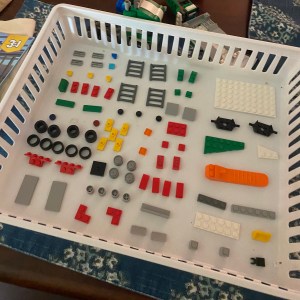
Laying Out the Pieces

A few weeks ago, when we were together for Easter, my sister’s son did the following for our older son.

As our son was putting his lego set together, his cousin carefully laid out the remaining pieces.

Good spiritual direction does something similar, I think. From a tangle of experience, a loving director is capable of mirroring back our experience in such a way that invites us into clarity.

Show Me the Way

In a poignant scene from the movie Romero, the saint is kneeling in prayer and says the following:

I can’t.

You must.

I’m yours.

Show me the way. 

The first time I heard it, I assumed that each line was a prayer uttered by Romero. So:

I can’t. (as prayer uttered)

You must. (as prayer uttered)

I’m yours. (as prayer uttered)

Show me the way. (as prayer uttered)

I have since wondered if this understanding is also possible:

I can’t. (as prayer uttered)

You must. (as answer received)

I’m yours. (as prayer uttered)

Show me the way. (as prayer received)

Or also, if this understanding is possible:

I can’t. (as answer received)

You must. (as answer received)

I’m yours. (as answer received)

Show me the way. (as answer received)

Other understandings are also conceivable, I think.  Each is a remarkable thing to consider as we take charge of the weight of reality.

Hand Them the Chalk

Think of that person who gets under your skin.  Maybe they do something that you do not like.  Maybe they do not believe what you believe or think how you think.

What would happen, though, if you became genuinely, intentionally curious about them?  What if there was no aversion, only an intense desire to learn how they see the world?

Here is one way in.  Picture yourself in a classroom with them.  Now, hand them the chalk and go sit down.  Let them teach you.  Don’t interrupt them.  Don’t prepare a rebuttal while they are talking.  Let them really sketch it all out for you.  Let them cover the whole board.

When we are able to listen like this, a whole world opens up.  Our vision becomes expansive.  We see that they, like us, carry fear, and this fear makes us all do things that don’t make sense.  We see a way forward in relationship.   

These days, I think this is what is meant, in the prayer of St. Francis, by the lines: “O Master, let me not seek as much…to be understood as to understand…”

The Empty Tomb

Have you read Pope Francis’ Easter Vigil homily?  It is worth it.  

This part was a gift to me.

“The first proclamation of the resurrection was not a statement to be unpacked, but a sign to be contemplated. In a burial ground, near a grave, in a place where everything should be orderly and peaceful, the women “found the stone rolled away from the tomb; but when they went in, they did not find the body” (vv. 2-3). Easter begins by upsetting our expectations. It comes with the gift of a hope that surprises and amazes us.” (emphasis added)

How can contemplation of this image, this sign, be a gift to us in places where we are stuck?

One More Paradox

Can I add one more paradox to the list of apparent contradictions that, when lived into, lead to a life of deep love?

Here it is.

That we have to feel and believe that we are enough in this moment in order to be transformed.

Put another way, the Spiritual Exercises have us, “know well that I’m loved even though oh so flawed” and lead on to “offer all I possess, beg for my stony-heart thawed, and act from a deep love, the love that is God.

The Opposite of Hope

What if we understood presumption to be the opposite of hope?

The presumption that only “we” have anything of worth to say.  That if it is not our truth, then it is a lie.  That truly listening to those people is not worth my time.  That fatalism is the only honest way to face the facts.

Presumption is one way to buffer ourselves from the weight of reality which, considered with clear perception, is quite heavy.  

Hope, though, entails a creative impulse that holds our engagement of reality ajar to love, to courage, and to daily commitment to take charge of the weight of reality.  

I do not think this “hope-holding-us-ajar” movement is something we do on our own, but it is possible to pray for.

Turning Down and Tuning In

Every time we sit down to talk with another person, it is, in a sense, a double date. We are each there, of course, but we have also brought along our inner voice, that chatter in our head about how the world (and the other person) should be.

That chatter keeps us from attending to the other, truly walking with them and loving them.

And we all have the chatter. (The times when we think we don’t are when it can get in the way the most.)

This chatter (and so the double date aspect) will never entirely go away, but conversations (and, over years, relationships) go better when we each do our part to turn down the volume on this inner commentary.

How to turn down the chatter? My best answer at the moment is to: 1) see it when it arises, and gently let it go, over and over for years, and 2) root in a reality bigger than ourselves so we do not think we need the chatter to control the world.

Let’s learn to turn down the chatter to tune in to each other.