Conspicuous consumption is exhausting. Its fruits are more restlessness, more false needs, (and so) more consumption. This is probably not what we actually want. “Nope. I’m good. I don’t need [that one more thing].” The freedom that springs from this attitude is attractive… more attractive in fact than whatever would have been conspicuously consumed.
Monthly Archives: May 2023
Oops!
In last week’s email, I neglected to send the link to the outstanding book that the picture was taken from. Apologies! Here it is: Thanks for the Feedback: The Science and Art of Taking Feedback Well.
Blindspot
Take a look at this picture.
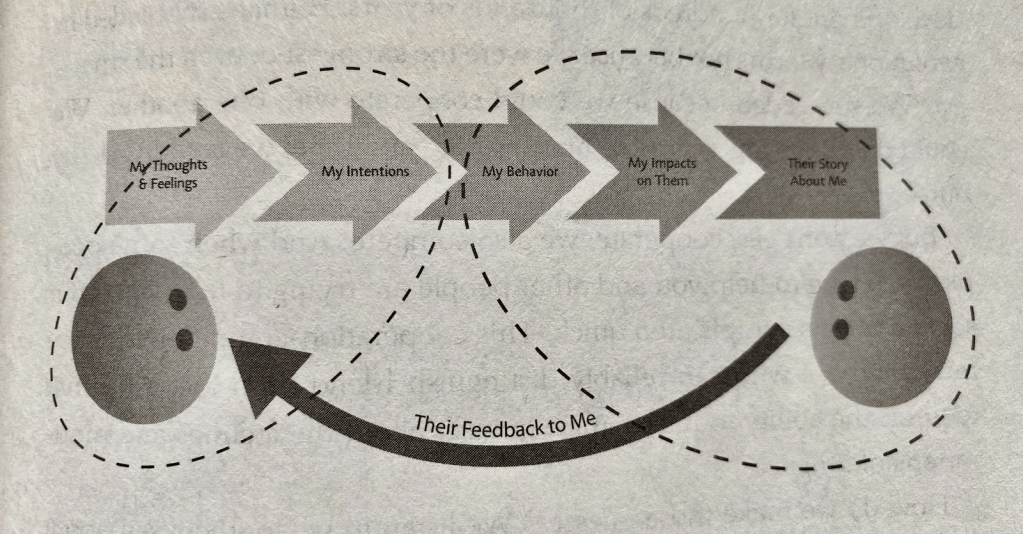
From pg. 81 of the wonderful Thanks for the Feedback by Stone and Heen
It is a diagram of what is happening when we do something and someone reacts to it. Pretty basic interaction, right?
Not at all! It is so complicated!
It turns out, that it is remarkably difficult to see our behavior (and the impact that it has) objectively.
Yes, we ideally have access to what is inside the left-hand, smaller circle… “my thoughts & feelings” and also “my intentions,” though even these are not always accessible to us depending on our inner state!
And then, we have partial knowledge of our behavior… partial because it is so hard to perceive our facial expressions, body language, and tone of voice.
And unless the other person chooses to share, we have no visibility on the things solely in the right-hand circle: “my impact on them” and “their story about me.” These form the basis of their feedback.
Our relationships (and so our life) get better when we have more visibility on our behavior and our impact on others.
So, where to start?
1. Mindfulness practice – This deepens and refines my perception of and receptivity to all of the inputs in the graphic.
2. Taking myself less seriously – Humor (particularly the self-deprecating kind) lowers the stakes for the person who might take the risk to clue us in on what we are missing.
Worldwide Available
Hey there friend! I know it is not quite Thursday, but I sent the email today because there is a time-sensitive invitation at the end…
Officers and their families in the US Foreign Service pledge to be “worldwide available.” Where there is a need, an FSO will go.
And “bidding season” (the time when it is decided where one will serve next) for us is approaching… so this global availability is felt acutely.
As we research possible postings, we look at the different aspects of life in a certain location… pollution, for example. In the process, it becomes shockingly clear that we would have a very hard time living in some places because of the air quality.
That is to say, what is not “worldwide available” is air that will not make you sick. But billions (billions!) of people live in those places every day, unable to choose a different home.
I think the technology that exists to confront this problem is just the coolest thing.
(Want to learn more about this sort of thing at a free virtual conference? Use this link to join virtual programing at the Claircon conference. The link includes a discount code,TCACC23, to receive free access. The conference takes place on May 19 & 20.
You’ll have the opportunity to dive into the engaging sessions in cleantech and sustainability, learn and interact with industry experts, network with like-minded people and discover innovative solutions for a greener future.)
How Fascinating!
I once heard of an orchestra conductor who trained all of his musicians to do the following.
Whenever they made a mistake, they were to raise their hands over their heads and proclaim, “How fascinating!”
Is this not a wonderful habit? To engage our mistakes with curiosity and playfulness?
This stance releases us from the compulsion to fabricate (and dig in behind) a self-justifying narrative. (It also skips over the reflex to just give up.)
That is to say, there is more time and energy left for becoming a more loving person.
When we are habituated to this mindset, everything is an opportunity to grow.
Communication Constraints
Here are some constraints on how we communicate things that matter to us.
1. In order to be heard, we must speak the message in the inner language of the one who we want to listen.
2. We typically see and hear people as we are, not as they are.
3. People can sense when they are not really being heard… and when this happens, they muffle and hide their true inner language. (After all, why waste the effort on someone who is not listening?)
Put another way, we have to demonstrate ourselves worthy (typically by offering non-judgmental, kenotic presence) of someone’s inner language.
4. We can’t speak a language we’ve never really heard.
Seeing all the potential problems that can arise?
In order to communicate effectively, we are going to have to stop thinking about how badly we want to be heard long enough to focus on that person and really see and hear them.
 Paul's Blog