In last week’s email, I neglected to send the link to the outstanding book that the picture was taken from. Apologies! Here it is: Thanks for the Feedback: The Science and Art of Taking Feedback Well.
Author Archives: Paul Mitchell
Blindspot
Take a look at this picture.
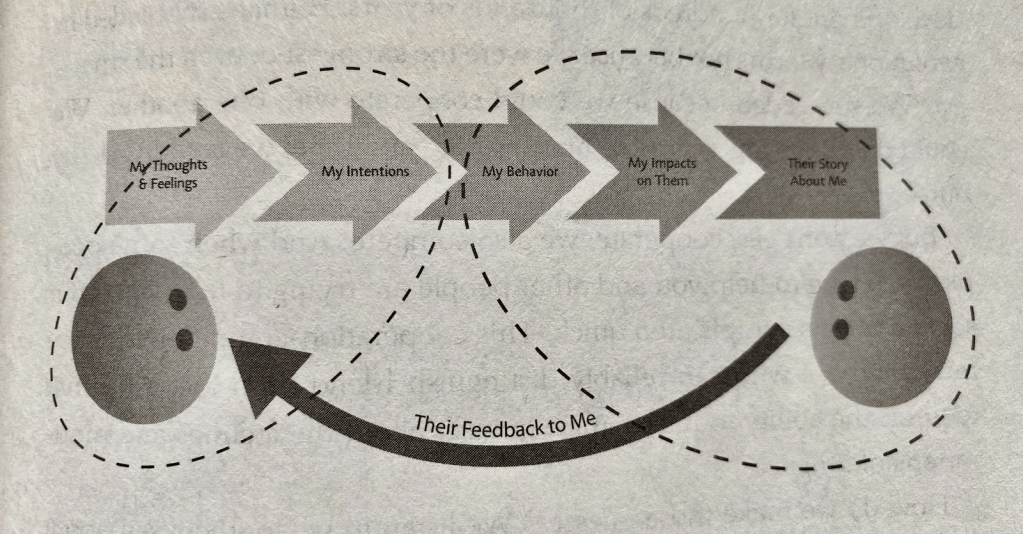
From pg. 81 of the wonderful Thanks for the Feedback by Stone and Heen
It is a diagram of what is happening when we do something and someone reacts to it. Pretty basic interaction, right?
Not at all! It is so complicated!
It turns out, that it is remarkably difficult to see our behavior (and the impact that it has) objectively.
Yes, we ideally have access to what is inside the left-hand, smaller circle… “my thoughts & feelings” and also “my intentions,” though even these are not always accessible to us depending on our inner state!
And then, we have partial knowledge of our behavior… partial because it is so hard to perceive our facial expressions, body language, and tone of voice.
And unless the other person chooses to share, we have no visibility on the things solely in the right-hand circle: “my impact on them” and “their story about me.” These form the basis of their feedback.
Our relationships (and so our life) get better when we have more visibility on our behavior and our impact on others.
So, where to start?
1. Mindfulness practice – This deepens and refines my perception of and receptivity to all of the inputs in the graphic.
2. Taking myself less seriously – Humor (particularly the self-deprecating kind) lowers the stakes for the person who might take the risk to clue us in on what we are missing.
Worldwide Available
Hey there friend! I know it is not quite Thursday, but I sent the email today because there is a time-sensitive invitation at the end…
Officers and their families in the US Foreign Service pledge to be “worldwide available.” Where there is a need, an FSO will go.
And “bidding season” (the time when it is decided where one will serve next) for us is approaching… so this global availability is felt acutely.
As we research possible postings, we look at the different aspects of life in a certain location… pollution, for example. In the process, it becomes shockingly clear that we would have a very hard time living in some places because of the air quality.
That is to say, what is not “worldwide available” is air that will not make you sick. But billions (billions!) of people live in those places every day, unable to choose a different home.
I think the technology that exists to confront this problem is just the coolest thing.
(Want to learn more about this sort of thing at a free virtual conference? Use this link to join virtual programing at the Claircon conference. The link includes a discount code,TCACC23, to receive free access. The conference takes place on May 19 & 20.
You’ll have the opportunity to dive into the engaging sessions in cleantech and sustainability, learn and interact with industry experts, network with like-minded people and discover innovative solutions for a greener future.)
How Fascinating!
I once heard of an orchestra conductor who trained all of his musicians to do the following.
Whenever they made a mistake, they were to raise their hands over their heads and proclaim, “How fascinating!”
Is this not a wonderful habit? To engage our mistakes with curiosity and playfulness?
This stance releases us from the compulsion to fabricate (and dig in behind) a self-justifying narrative. (It also skips over the reflex to just give up.)
That is to say, there is more time and energy left for becoming a more loving person.
When we are habituated to this mindset, everything is an opportunity to grow.
Communication Constraints
Here are some constraints on how we communicate things that matter to us.
1. In order to be heard, we must speak the message in the inner language of the one who we want to listen.
2. We typically see and hear people as we are, not as they are.
3. People can sense when they are not really being heard… and when this happens, they muffle and hide their true inner language. (After all, why waste the effort on someone who is not listening?)
Put another way, we have to demonstrate ourselves worthy (typically by offering non-judgmental, kenotic presence) of someone’s inner language.
4. We can’t speak a language we’ve never really heard.
Seeing all the potential problems that can arise?
In order to communicate effectively, we are going to have to stop thinking about how badly we want to be heard long enough to focus on that person and really see and hear them.
How Not to Receive a Gift
Imagine that we each have just received a free and mysterious gift – one that, when explored, grew more and more wonderful.
Here is a list (not exhaustive!) of how I should probably not receive this gift.
-Convince myself it is not that cool anyway, and not really engage it.
-Try to subtly earn it, and thereby convince myself that I control the gift.
-Trash it.
-Tell myself that I do not deserve it, and thereby excuse myself from encountering the wonder of the thing.
-Otherwise ignore or neglect it.
I’d be silly to do these things, right?
And yet I know that I have, in one form or another, with the free gifts of my inner life, outer life, the earth, my mind and body.
Let’s agree to receive these gifts in wonder and, humbled by their depth, attend to each with deep love.
The Way We Play
I once heard this story of a student auditioning at a school of music.
He had exhaustively prepared his audition piece. During the actual audition, though, the instructor interrupted him almost immediately and asked him to play it differently.
That’s great. Now, play it at double speed.
Now, play it at half speed.
Now, play it like Adele sings.
Now play it like Santana.
Now play it like Dylan.
The teacher wanted to see how well the student adapted to the challenge of changing his default mode.
In life, we typically have a default “way we play.” Call it our personality, or our narrative, or our way of being. It has helped us survive this long and do some things well.
Crucial to the skill of living artfully, though, is beginning to see this “way we play” as limited, learn to experiment with playing differently, and then watch new doors open wide.
Playing to Learn
The few times that I have shadowed our sons in their (mostly German-speaking) school, I’ve gained an appreciation of how difficult it must be to be immersed in a new language in that context. Yes, young brains can pick up language fast, but going from zero to playground proficient is still a hard thing.
Lately, at home, we have noticed that they are most likely to practice their German when they are playing. Either alone or together, they play with both toys and language. They get in a lot of hours of practice that way and the German becomes part of their joy.
So: that new thing we want (or need) to learn… how can our learning feel like play?
Elders
When we moved into our house last summer, I found that someone had left an unassuming book in the dresser… an independently published book, “20 Walks from Munich.” Each of the twenty walks is exhaustively (and often hilariously) detailed, like a pirate map in a children’s story. (As in: “Look to the left. Do you see the big rock? Walk past it and turn right.”)
When I tried out the first walk, I was looking up and down from the book every few minutes. I was a novice and wondered often if I was on the correct path. But the more I walked, the more I saw folks in their sixties and seventies in small groups on the very path that my book was describing.
They knew the way by heart.
I put away the book and followed where they were walking.
Our modern life typically does not prioritize listening to elders, but it could and, in many cases, should. The elders have walked this way before.
I Can’t See My Face!
The other morning, our four-year-old emphatically observed:
“Did you know that I can’t see my face?!?”
And he is right! Without a mirror (or the like), one cannot see the non-verbal cues that their face communicates.
This reality is kind of a bummer, too, since the face gives off a huge amount of information, and we have evolved to subconsciously interpret even the smallest, quickest emotion on the face of another.
So, what do you hope to unconsciously communicate?
The answer may represent yet another reason for committing to a slower, simpler life and to mindfully accept what we feel when we feel it.
Because I can’t see my face, but everyone else can.
 Paul's Blog